
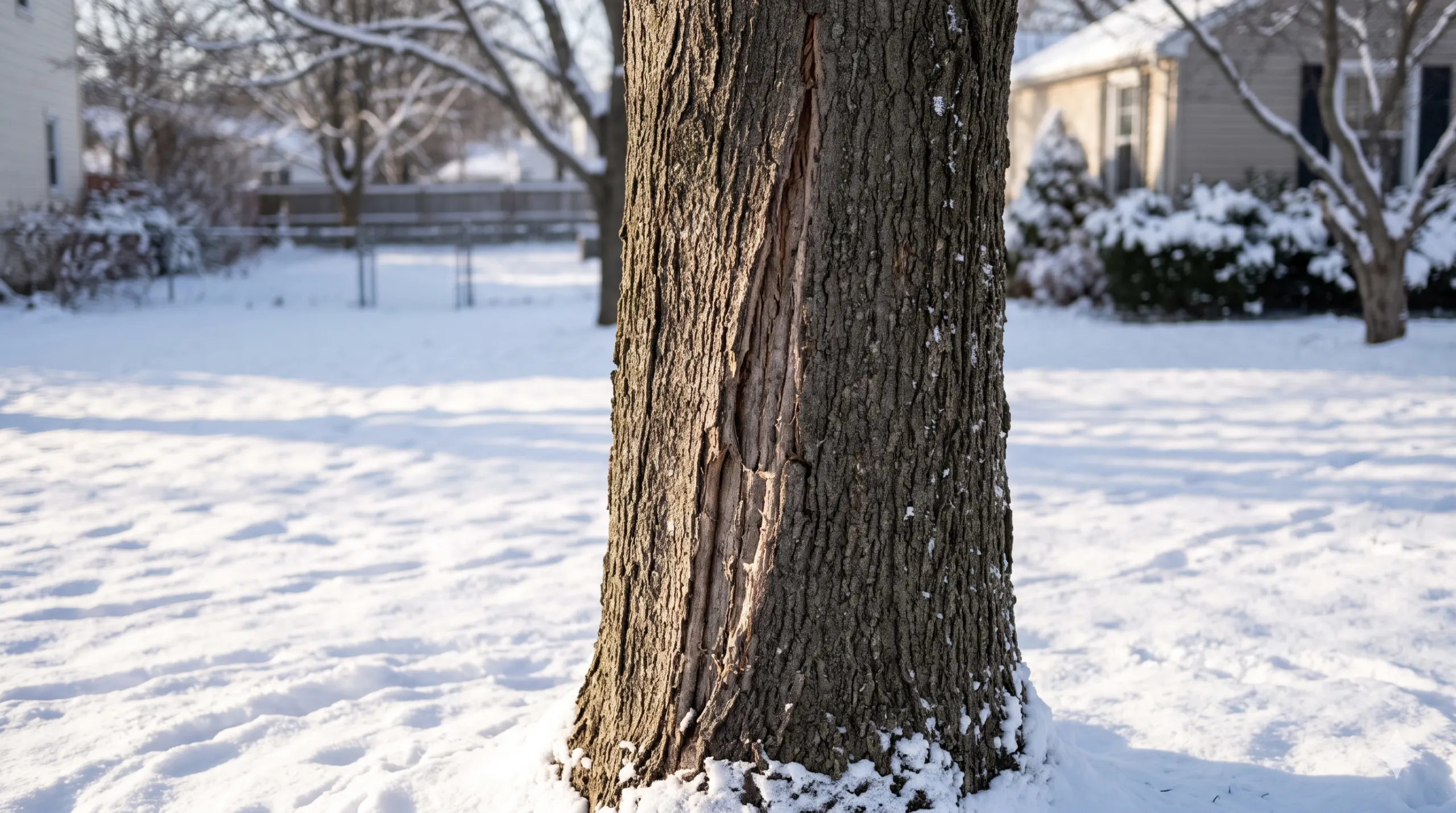
When a bright, sunny afternoon in Western New York suddenly plunges into a bitter, below-zero night, the trees in your yard endure immense physical stress. Many Buffalo homeowners expect heavy lake-effect snow or high winds off Lake Erie to snap overhead branches, yet one of the most destructive winter injuries happens silently—or with a sudden, sharp crack like a rifle shot—right along the main stem of the tree. Understanding how to spot early structural stress and scheduling preventative tree trimming and pruning in Buffalo, NY, before harsh freeze-thaw cycles take hold can save mature shade trees from irreversible internal decay and catastrophic trunk failure.
At Skyline Tree Care, operating out of our yard at 332 Cable St in Buffalo, our crew regularly inspects residential properties across Erie County after sharp January and February cold snaps. What looks like a harmless cosmetic crease in the bark during midwinter often signals deep mechanical separation inside the heartwood. Knowing what to look for, why Western New York’s climate triggers these ruptures, and how to respond safely will help you protect both your landscape investment and your home.
Understanding the Mechanics Behind Winter Trunk Ruptures
To recognize the warning signs of a frost crack, it helps to understand the physics occurring beneath the bark. Unlike humans, trees do not generate internal body heat; they rely on dormancy, cellular sugar concentrations, and bark insulation to survive sub-freezing temperatures.
During a crisp, cloudless winter day in Buffalo, low-angle afternoon sunlight hits the south and southwest sides of a tree trunk directly. Even when air temperatures hover near freezing, dark or thin bark absorbs solar radiation, warming the outer layers of wood and causing the cells to expand slightly. As soon as the sun drops below the horizon, temperatures plummet rapidly. The outer bark and sapwood cool and contract much faster than the insulated inner heartwood.
This differential contraction builds extreme circumferential tension across the trunk. When that tension exceeds the tensile strength of the wood fibers—especially if the trunk already harbors an old wound, improper pruning cut, or internal decay—the wood ruptures vertically along the grain.
Frost Cracks vs. Sunscald: Recognizing the Difference
Homeowners frequently confuse frost cracks with sunscald, as both occur on the sun-exposed south or southwest face of a trunk during winter. While related, they represent distinct types of tissue damage:
| Feature | Winter Frost Crack | Winter Sunscald |
| Primary Cause | Rapid temperature drop causes outer wood to contract faster than inner wood. | Afternoon sun warming dormant bark cells, followed by freezing temperatures killing active tissue. |
| Visual Appearance | Long, vertical split extending deep into the woody tissue; may open and close with temperature swings. | Sunken, discolored, or flattened patch of dead bark that eventually peels or flakes away in spring. |
| Sound / Formation | Often splits abruptly during severe cold snaps, sometimes producing a loud snapping sound. | Develops gradually over late winter; tissue death becomes visible once spring growth resumes. |
| Long-Term Impact | Compromises structural load-bearing capacity and creates a deep pathway for wood-decay fungi. | Exposes underlying sapwood to borers and canker diseases, though structural wood remains intact initially. |
Frequently Asked Questions
Why do frost cracks almost always happen on the south or southwest side of a tree?
In the Northern Hemisphere, the low winter sun shines most directly on the south and southwest sides of vertical trunks during the warmest part of the afternoon. This creates the sharpest temperature swing between afternoon solar heating and overnight freezing.
Can a tree suffer from both sunscald and a frost crack at the same time?
Yes. Sunscald kills a patch of bark and cambium tissue, creating a weak, rigid scar along the trunk. In subsequent winters, thermal contraction stresses concentrate right at that dead tissue boundary, frequently triggering a deep vertical frost crack.
Primary Warning Signs of Frost Cracks and Trunk Ruptures
Catching a trunk rupture early requires inspecting your trees during cold spells—not waiting until May when leaves emerge. Because frost cracks frequently pull back together when daytime temperatures rise above freezing, a severe structural split can easily go unnoticed during a mild February thaw.
1. Narrow Vertical Splits on South or Southwest Trunks
The clearest sign of an active frost crack is a straight, vertical fissure running parallel to the wood grain, typically starting a few inches above the root flare and extending anywhere from one to several feet up the trunk. Inspect the south and southwest sides of your trees right after an overnight temperature plunge. You may see exposed, lighter-colored inner wood inside a gap ranging from a hairline fracture to over an inch wide.
2. Raised Vertical Callus Ribs (“Frost Ribs”)
If a tree suffered a frost crack in a previous Buffalo winter, it attempts to seal the wound during spring and summer by growing layers of callus tissue along both edges of the split. Because wood is weaker along that seam, subsequent winters often force the crack open again. Over several years, repeated cycles of splitting and callusing create a prominent, raised vertical ridge protruding outward from the trunk. A pronounced frost ring indicates chronic structural weakness that warrants professional tree care evaluation.
3. Curling, Loose, or Lifting Bark Strips
Before a deep structural rupture fully opens, the outer bark along a stressed seam often begins to curl outward or separate from the underlying cambium layer. If you gently press the bark adjacent to a vertical seam and feel a hollow pocket or spongy movement beneath your fingers, the bark has detached from the wood, leaving a sheltered cavity where moisture and overwintering insects accumulate.
4. Dark Oozing or Frozen Sap Trails
While heavy sap flow is usually associated with spring thaws, sudden winter trunk ruptures in species like maples and birches can sever active vascular vessels. When daytime sun warms the trunk, moisture or sugary sap may seep out of the fissure, leaving dark vertical stains on the bark or freezing into thin amber icicles along the split edge.
5. Sudden Canopy Lean or Widening Branch Unions
A trunk rupture does not always stay confined to the lower stem. When a vertical split extends upward into a co-dominant stem union—where two main trunks fork at a narrow V-shaped angle—the mechanical integrity of the entire upper crown is threatened. Watch for subtle shifts in canopy symmetry, gaps opening inside a main crotch, or heavy limbs sagging lower than usual after wet snowfalls.
Frequently Asked Questions
Why did the crack in my maple tree disappear when the weather warmed up?
Frost cracks are driven by thermal contraction. When daytime temperatures rise above freezing, the outer sapwood expands back toward its normal volume, pulling the edges of the fissure tightly shut. Even when closed, the internal wood fibers remain separated beneath the bark.
How deep into the trunk does a typical frost crack go?
A true frost crack penetrates past the outer bark and cambium directly into the sapwood and heartwood. On severe ruptures, the split can extend several inches toward the center of the trunk, creating a permanent internal seam.
Why Buffalo’s Microclimate Accelerates Winter Trunk Damage
Trees growing in North Buffalo, Elmwood Village, Amherst, Tonawanda, Cheektowaga, and West Seneca face a unique combination of winter stressors that amplify the risk of trunk ruptures compared to milder inland regions:
- Lake-Effect Temperature Whiplash: Open water on Lake Erie early in the winter season moderates daytime temperatures, only for Arctic fronts to sweep across the Niagara Frontier and drop temperatures by 30°F or more within hours.
- High Albedo from Deep Snowpack: Thick blankets of snow reflect intense winter sunlight directly onto the lower trunks of yard trees, doubling the thermal load on south-facing bark during clear afternoons.
- Freeze-Thaw Saturation Cycles: Repeated thaws allow meltwater to penetrate tiny bark crevices. When that water freezes overnight, ice expansion acts like a hydraulic wedge, prying hairline fissures wider with every cycle.
- Road Salt and Soil Compaction: Street trees and front-yard specimens near plowed driveways experience root-zone dehydration from de-icing salts and compacted soil. Dehydrated wood fibers are significantly more brittle and prone to snapping under thermal contraction.
Frequently Asked Questions
Does deep snow around the base of a tree protect it or harm it?
Snow acts as a ground insulator for roots, which is beneficial, but high snowdrifts reflect intense UV and solar heat onto the exposed upper trunk while inviting rodents to chew bark just beneath the snowline.
Why do street trees near the curb split more often than backyard trees?
Curbside and driveway trees face compacted soil, restricted root zones, reflected heat from asphalt, and de-icing salt runoff. These stresses dehydrate vascular tissues, making the wood far less flexible during rapid freezes.
Tree Species in Western New York Most Vulnerable to Frost Cracks
Not every tree in your yard carries the same level of risk. Thick-barked mature oaks and pines possess natural thermal insulation that buffers internal wood against rapid temperature swings. Conversely, thin-barked species and trees with dense, interlocking wood grains struggle to absorb rapid thermal expansion and contraction.
If you have any of the following species on your property, make winter trunk inspections part of your seasonal routine:
- Maples (Red Maple, Silver Maple, Norway Maple, Sugar Maple): Among the most commonly planted shade trees across Buffalo neighborhoods, maples have relatively thin, smooth bark when young and frequently develop long south-facing frost cracks and multi-year frost ribs.
- Lindens (Littleleaf Linden and American Basswood): Thin bark and rapid growth rates make lindens highly susceptible to vertical splitting on exposed lawns.
- Ornamental and Fruit Trees (Crabapple, Apple, Cherry, Plum): Shallow-rooted and thin-barked, orchard and ornamental specimens suffer frequent sunscald and winter trunk fissures if left unshaded.
- Ash, Sycamore, and Horse Chestnut: Older specimens—especially ash trees already weakened by emerald ash borer galleries—experience severe internal tension when moisture freezes inside compromised sapwood. If an infested ash develops deep vertical splits, prompt hazardous tree removal in Buffalo, NY is often the safest course of action.
- Tulip Trees and Beeches: Smooth-barked trunks readily absorb afternoon solar heat, leading to sudden longitudinal splits during sub-zero nights.
Frequently Asked Questions
Are mature trees safer from frost cracks than newly planted trees?
Generally, yes, because older trees develop thicker, furrowed corky bark that insulates the inner sapwood. However, mature maples and lindens with old mower wounds, flush pruning scars, or internal decay remain highly prone to sudden trunk ruptures.
Do evergreen trees like spruce and pine ever get frost cracks?
Evergreens rarely suffer from classic south-facing frost cracks because their dense lower branches shade the trunk year-round and their resinous, textured bark buffers rapid temperature changes.
Immediate Actions to Take When You Spot a Trunk Rupture
Discovering a three-foot split down the side of a prized shade tree is alarming, and many homeowners instinctively reach for DIY repair products. Unfortunately, traditional “quick fixes” almost always accelerate long-term rot.
What NOT to Do
- Never apply wound paint, tar, or pruning sealer: Sealing a frost crack traps moisture and fungal spores inside the wood, suffocating the tree’s natural compartmentalization process and turning a treatable split into hollow heart rot.
- Do not pack the crack with caulk, foam, or cement: Foreign materials expand and contract at different rates than living wood, preventing the crack from closing naturally during warmer weather and tearing new callus tissue.
- Avoid heavy mid-winter pruning of healthy limbs: Stripping healthy lower branches in January exposes previously shaded bark to direct winter sunlight, worsening thermal shock.
Safe, Practical Steps for Homeowners
- Document the Split: Take clear photos of the crack along with a ruler or tape measure to record its length and width. Note the date and overnight low temperature so you can track whether the fissure closes when temperatures rise.
- Check for Loose, Hanging Bark: If jagged strips of dead bark are hanging loose and collecting snow or ice, carefully trim away only the detached outer edges with a clean, sharp blade without cutting into living green cambium tissue.
- Inspect the Canopy for Hazards: Look straight up from the base of the trunk. If the split aligns directly beneath a heavy, snow-laden limb overhanging your roof, driveway, or sidewalk, keep family members and vehicles clear until an arborist assesses structural stability.
- Schedule a Professional Structural Assessment: Our crew can probe the depth of the fissure, determine whether internal decay is present, and recommend structural tree cabling and bracing or targeted crown weight reduction to relieve mechanical stress on the trunk.
Frequently Asked Questions
Should I wrap a rope or ratchet strap around the trunk to pull the split closed?
No. Tight straps or wires girdle the living cambium layer beneath the bark, cutting off nutrient transport and killing the tree from the wrap point upward. If mechanical bracing is needed, an arborist uses specialized threaded steel rods installed through the wood.
Can I clean inside the frost crack with bleach or a garden hose?
Never spray water or household chemicals into a trunk split. Introducing moisture feeds wood-decay fungi, while bleach burns delicate living callus cells trying to seal the margin.
How Strategic Tree Maintenance Prevents Winter Trunk Failure
While no one can control Western New York weather, proactive tree care dramatically lowers the odds of severe frost cracking. Healthy, well-hydrated trees with balanced canopies distribute mechanical stress evenly and seal minor bark injuries rapidly.
- Deep Fall Root Watering: Before the ground freezes solid in late November, give young and thin-barked trees a slow, deep soaking. Fully hydrated wood cells resist winter desiccation and handle thermal contraction far better than drought-stressed wood.
- Proper Mulching Technique: Spread a 2- to 3-inch layer of organic shredded hardwood mulch out to the drip line, keeping it pulled back 3 to 4 inches from the trunk flare. Mulch insulates soil moisture without trapping dampness against the lower bark.
- Seasonal Trunk Wrapping for Young Trees: For newly planted maples, lindens, and fruit trees under five years old, apply a breathable, light-colored paper tree wrap in late November. Light colors reflect afternoon sunlight to prevent bark overheating. Always remove the wrap in early April so moisture and insects do not shelter beneath it during spring.
- Structural Crown Thinning and Deadwood Removal: Removing dead, crossing, or overextended branches during late-fall or dormant-season residential tree trimming and pruning reduces wind sail and snow-load leverage on the main trunk. Eliminating weak co-dominant stems early prevents splits from propagating down the trunk.
- Avoid Mower and String-Trimmer Wounds: Mechanical nicks at the base of a tree create permanent stress risers. Nearly 80% of severe frost cracks originate from an old lawnmower gouge, flush pruning cut, or buried girdling root.
Frequently Asked Questions
Is winter a good time to prune trees in Buffalo?
Yes, dormant-season pruning between late fall and early spring is ideal for most deciduous trees. Without leaves blocking visibility, arborists can clearly spot structural defects, weak branch unions, and early trunk seams while minimizing pest and disease transmission. However, cuts must stay outside the branch collar so they do not create new stress points for frost cracking.
What happens if I leave tree wrap on year-round?
Leaving paper or plastic trunk guards on through spring and summer traps rain against the bark, softens outer protective layers, and creates an ideal shelter for borers and fungal cankers. Always install wraps in November and remove them in April.
When a Frost Crack Becomes an Emergency Removal Situation
Most clean, single frost cracks on otherwise vigorous trees seal themselves over one or two growing seasons without threatening the life of the tree. However, certain warning signs indicate that a trunk rupture has compromised the structural safety of the tree beyond recovery:
- Multiple Intersecting Cracks: Two or more vertical splits running up opposite sides of the trunk divide the stem into independent pillars that can twist and shear apart in high winds.
- Visible Fungal Conks or Mushrooms: Shelf fungi or mushrooms emerging from or adjacent to a frost crack prove that internal heartwood decay has already set in.
- Crumbly, Punky Heartwood Inside the Fissure: If the wood visible inside the crack looks dark, fibrous, or soft enough to crumble with a stick, structural strength is severely degraded.
- Active Splitting Near a Major Branch Union: A rupture extending directly into a heavy crotch union poses an immediate risk of half the crown tearing away onto nearby structures.
- Root Plate Heaving: If soil is lifting or cracking on the side opposite a fresh trunk split, the tree’s anchoring root system is failing alongside the stem.
If you observe any of these red flags after a winter storm or sudden freeze, contact our 24/7 emergency tree service team immediately at (716) 576-3900 to secure your property before high winds off Lake Erie trigger a collapse.
Frequently Asked Questions
Will a frost crack kill my tree on its own?
In most cases, no. A vigorous tree compartmentalizes a clean vertical split by forming protective callus wood along the edges. The real danger is wood-rotting fungi entering the open fissure and hollowing out the structural heartwood over several years.
How much does it cost to evaluate or treat a cracked tree in Erie County?
Minor crown weight reduction or deadwood pruning typically costs a few hundred dollars depending on tree height and access, whereas hazardous tree removal for a large mature maple with a severe trunk rupture varies based on proximity to structures and utility lines. Scheduling an on-site inspection gives you an accurate assessment before a manageable split turns into an emergency.
Finding Reliable Tree Trimming and Pruning Near Me in Buffalo, NY
When a winter cold snap leaves a fresh vertical split down a mature maple or oak in your yard, waiting weeks for an out-of-town contractor puts your home at risk. Homeowners searching for emergency tree evaluation or preventative tree trimming and pruning near me in Western New York need a local crew that understands Buffalo’s lake-effect snow loads, clay-heavy soils, and municipal street-tree regulations.
From our headquarters at 332 Cable St in Buffalo, Skyline Tree Care dispatches experienced, fully insured arboricultural crews across Erie County. Whether you are dealing with a frost-damaged silver maple near Delaware Park and Elmwood Village, storm-stressed limbs in North Buffalo and Kenmore, or overgrown canopies in Amherst, Williamsville, Tonawanda, Cheektowaga, West Seneca, Orchard Park, and Clarence, our team provides fast on-site structural assessments, safe dormant-season pruning, and complete stump grinding and removal.
Why Erie County Homeowners Choose Skyline Tree Care
- Local Climate Expertise: We tailor structural crown thinning and weight reduction specifically for trees exposed to Lake Erie wind gusts and rapid freeze-thaw cycles.
- Non-Invasive Diagnostic Care: We never recommend harmful wound paints or unnecessary removals when targeted cabling, deadwood removal, or seasonal care can save a healthy tree.
- Full Cleanup & Property Protection: Every pruning and removal job includes complete brush chipping, trunk hauling, and careful lawn protection—even on frozen or snow-covered ground.
Service Area Map & Direct Contact
Need a local arborist near you to inspect a winter frost crack before spring thaw? Visit our Google Business Profile to read recent reviews from your Erie County neighbors, get directions to our yard, or request a free on-site tree estimate today: