
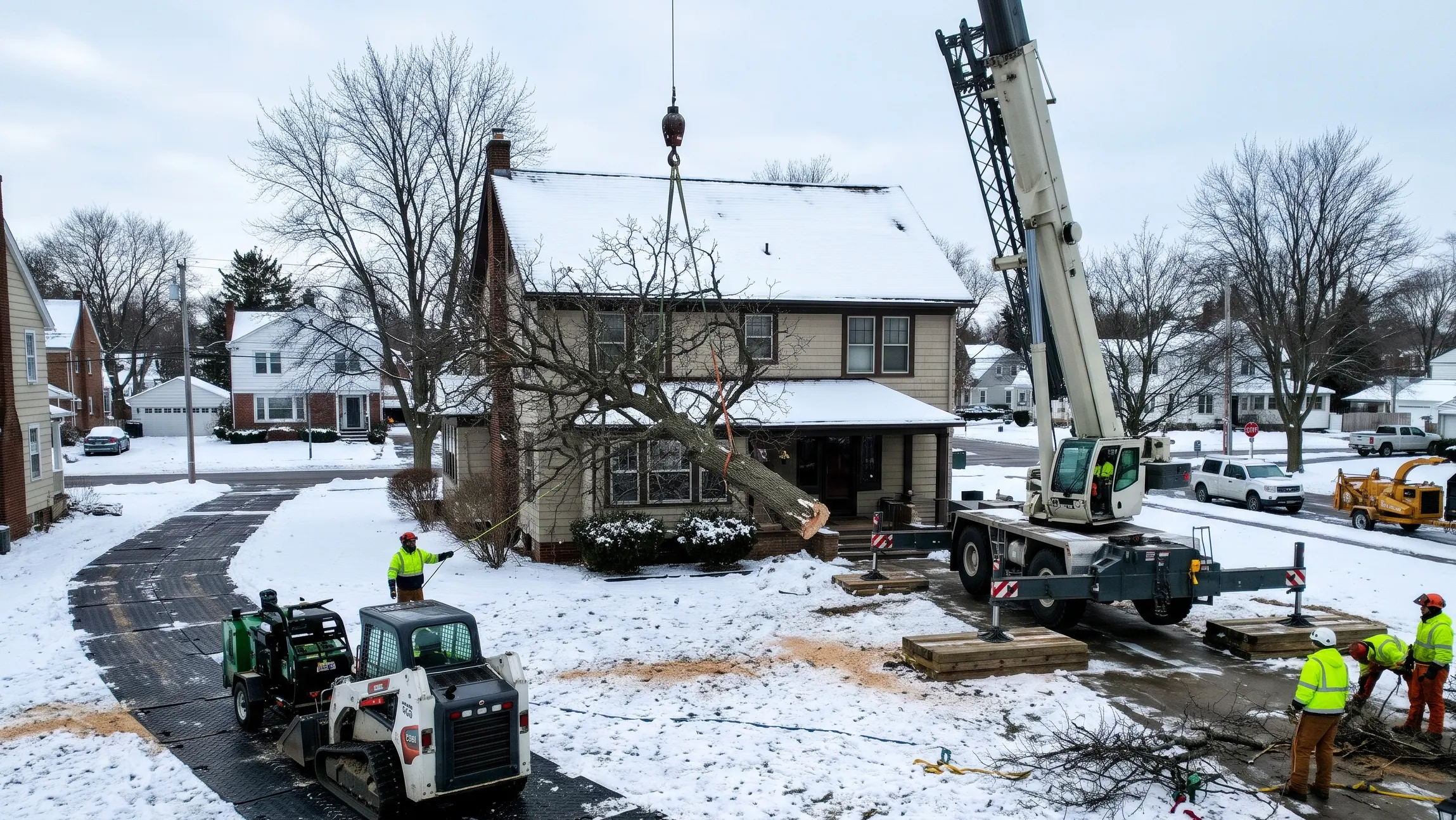
When Western New York homeowners look out at a dormant, snow-dusted lawn in January or February, scheduling a major arboricultural project is rarely the first thing on their minds. Yet for property owners needing professional tree removal in Buffalo, NY, the middle of winter is often the single best window on the calendar to protect delicate landscaping, established turfgrass, and underground root systems. Heavy-duty cranes, grapple trucks, and complex rigging operations place tremendous downward force on residential yards. When that work happens on soft spring mud or sun-baked summer topsoil, even the best protective plywood can leave behind compressed soil and torn sod. When that exact same work happens over deeply frozen Western New York soil, the ground itself becomes a structural load-bearing slab that shields your lawn from the ground up.
At Skyline Tree Care, our crews operate year-round out of our headquarters at 332 Cable St, Buffalo, NY 14206, just off the I-190 and Clinton Street corridors, serving homeowners across Erie and Niagara counties. Over years of hoisting multi-ton oak, silver maple, and cottonwood logs over historic slate roofs in Elmwood Village, tight side yards in North Buffalo, and sprawling lots in Orchard Park and Amherst, we have seen firsthand how winter soil physics change the game for turf preservation. Understanding why frozen earth resists compaction—and how modern crane-assisted rigging pairs with winter ground conditions—can save you thousands of dollars in spring lawn restoration while keeping hazardous trees from threatening your home during late-winter ice storms.
The Physics of Soil Compaction and Why Residential Lawns Suffer
To appreciate what frost does for a residential yard, it helps to look at what happens beneath your grass blades during warmer months. Healthy lawn soil in Western New York is roughly half solid mineral particles and organic matter and half pore space filled with air and water. Those microscopic pores allow rainwater to percolate downward, oxygen to reach turfgrass roots, and earthworms and beneficial microbes to cycle nutrients.
When a 40-ton hydraulic crane, a bucket truck, or a skid-steer loader rolls across unfrozen lawn soil, the weight presses down on those air and water pockets. Water cannot be compressed, so it is forced sideways, and the solid soil particles collapse into the empty air spaces. This process, known as soil compaction, turns resilient, sponge-like topsoil into a dense, brick-like layer.
The consequences of warm-weather equipment compaction show up long after the tree crew packs up its ropes:
- Suffocated turf roots: Grass roots require oxygen to respire and absorb nutrients. Compacted soil starves the root zone, leading to thin, yellowing turf that struggles to survive July heat waves.
- Surface water pooling: Without open macropores to drain snowmelt and Lake Erie rainstorms, water sits on top of the lawn, drowning healthy grass and encouraging moss, fungal diseases, and mosquito breeding.
- Sheared sod and ruts: Turning tires on damp spring clay tears grass crowns right out of the soil, leaving deep ruts that require topsoil fill, grading, reseeding, and months of watering to repair.
- Subsurface utility and irrigation stress: Saturated soil shifts under heavy outrigger loads, transferring uneven pressure onto shallow sprinkler lines, septic lateral fields, and French drains.
Even when tree care professionals lay down high-density polyethylene ground protection mats, soft, saturated spring mud can flex underneath the mats, creating subtle depressions across a pristine yard.
Frequently Asked Questions
Can core aeration in the spring easily fix compaction caused by heavy tree equipment?
Standard residential core aeration only penetrates about 2 to 3 inches into the topsoil. Heavy crane outriggers and loaded log trucks compress soil 8 to 14 inches deep, well below the reach of a walk-behind aerator. Preventing that deep compaction in winter is far more effective than trying to reverse it in spring.
Why does turning a truck or loader on damp grass cause worse damage than driving straight?
When heavy tires pivot or turn on soft, unfrozen turf, lateral shear forces twist the grass blades and rip the shallow root crowns loose from the mud. Even if the ground does not sink deeply, that tearing action kills the turf along the tire track.
How Deep Frost Turns Your Yard into a Natural Load-Bearing Bridge
Winter in Buffalo fundamentally alters the mechanical properties of soil. As sustained freezing temperatures penetrate below the turf layer, the moisture held inside soil pores freezes into solid ice crystals. Because ice bonds individual soil mineral grains together into a rigid, continuous matrix, the ground gains dramatic compressive and shear strength.
Instead of behaving like a deformable sponge, frozen soil acts like a thick sheet of reinforced concrete resting over the softer subsoil below.
Distributing Weight Over a Wider Cone of Influence
In civil and geotechnical engineering, loads applied at the surface spread outward at an angle as they travel downward—a concept known as the pressure bulb or cone of influence. In soft, unfrozen loam or heavy Erie County clay, that pressure concentrates directly beneath a tire tread or crane outrigger pad, pushing soil downward and outward into ruts.
When the top 8 to 18 inches of ground are solidly frozen, that rigid frost crust distributes concentrated point loads horizontally across a much wider area before the force ever reaches the unfrozen soil underneath. By the time the downward pressure reaches the lower soil layers, the pounds-per-square-inch (PSI) load has dropped well below the threshold required to crush soil pores.
Dormant Grass Blades Resist Abrasion and Shearing
Protection during winter crane work is not just about what happens below the surface; it also protects the living grass plants on top. Cool-season turfgrasses common to Western New York—such as Kentucky bluegrass, perennial ryegrass, and tall fescue—enter physiological dormancy once soil temperatures consistently drop below 45°F.
During dormancy, the grass pulls moisture and carbohydrates down into its crown and root system, leaving dry, resilient top growth above ground. Unlike lush, water-filled spring shoots that bruise, crush, and rot when driven over, dormant turf blades bend without rupturing cell walls. Combined with a protective layer of snowpack or professional ground mats, the grass crowns remain completely insulated from tire friction and foot traffic, emerging green and intact when April sunshine returns.
Frequently Asked Questions
How deep does the ground in Buffalo need to freeze to support heavy equipment?
For most residential tree care trucks and compact loaders, a solid frost layer of at least 6 to 8 inches provides reliable load distribution, especially when paired with ground protection mats. For heavy hydraulic cranes positioned off-pavement, 10 to 18 inches of deep mid-winter frost offers ideal structural bridging.
Does driving over dormant winter grass kill the roots underneath?
No. Once cool-season turfgrasses enter winter dormancy, their growing points (crowns) sit tucked firmly at the soil surface, protected by frozen earth and dry thatch. As long as equipment does not spin its tires or scrape bare frozen soil, the dormant grass rebounds cleanly as soon as soil temperatures rise in April.
Why Crane & Rigging Operations Benefit Most from Frozen Ground
Not every tree removal requires a crane, and not every crane job happens in winter. However, when a massive, declining tree stands behind a house, wedged between a garage, a pool, and overhead service drops, crane-assisted dismantling is often the safest and lowest-impact method available. Pairing crane rigging with frozen winter turf multiplies that low-impact advantage.
Text Comparison: How Ground Conditions Change Crane Load Behavior
- On Soft Spring or Summer Soil: Heavy tire treads and crane outriggers concentrate downward pressure straight into saturated topsoil. Sod shears under turning wheels, soil pores collapse into deep compaction, and water pools over crushed roots long after the job ends.
- On Frozen Western New York Winter Soil: An 8- to 18-inch layer of frozen earth acts like a rigid structural slab beneath our ground protection mats. Downward weight spreads horizontally across a wide subsurface area, leaving the underlying soil pores open, aerated, and undisturbed.
Zero Dragging Across the Lawn
In traditional backyard tree work without a crane, limbs and heavy trunk sections are lowered on ropes and either hauled out by hand or dragged to the street with a compact loader. Every trip across the yard multiplies surface wear.
With a hydraulic crane positioned safely in the driveway or street—or carefully set on frozen ground—our rigging crew attaches heavy-duty slings directly to sections of the canopy and trunk. Once our climber or bucket operator makes the precision cut, the crane operator lifts the entire section vertically into the air, swings it smoothly over the house, and sets it directly beside the chipper and log truck at the curb. Nothing touches your lawn, your perennial beds, or your backyard fence.
Stable Outrigger Footing on Solid Frost
A crane is only as stable as the ground supporting its outriggers. During wet spring thaws, stabilizing a heavy crane requires extensive cribbing stacks to prevent outrigger pads from sinking into soft turf. Deep winter frost provides a naturally firm, unyielding foundation. At Skyline Tree Care, we still deploy engineered composite cribbing blocks and ground protection mats beneath every outrigger pad—even in January—to prevent localized heat transfer or surface scuffing, giving our operators rock-solid stability while leaving zero imprint on your grass.
Clean Brush and Sawdust Removal
Anyone who has watched a tree removal in July knows how difficult it is to rake fine sawdust and twig fragments out of thick, damp green grass without pulling up turf runners. In winter, sawdust and small wood chips land cleanly on top of frozen snowpack or dormant grass blades. Our ground crew can blow or rake the workspace spotless in a fraction of the time, leaving zero organic debris behind to smother your lawn in spring.
Frequently Asked Questions
How close does the crane need to get to my tree?
Depending on the boom length and tonnage capacity required for your tree’s weight, our cranes can often remain completely on your concrete or asphalt driveway—or on the street with proper city permits—reaching 80 to 120+ feet over your house into the backyard. When a crane stays on pavement, your lawn sees virtually zero vehicle weight from start to finish.
Is crane rigging safe in cold winter temperatures?
Yes, provided the crew uses winter-rated hydraulic fluids, inspects wire ropes and synthetic slings for ice buildup, and accounts for wind chill. Modern hydraulic cranes operate reliably in sub-freezing temperatures, and cold, dry winter air often brings calmer, steadier wind conditions than volatile spring storm fronts.
Buffalo’s Unique Soil and Winter Climate Advantage
Western New York has distinct geological and meteorological characteristics that make winter rigging especially advantageous compared to milder regions.
Dealing with Heavy Erie County Clay
Much of the Buffalo metro area—from Cheektowaga and Lancaster down through West Seneca and Hamburg—sits on dense glacial lake-plain clay and silty loam. While rich in minerals, clay soil is notoriously slow to drain and highly vulnerable to structural damage when worked wet. A single afternoon of heavy equipment traffic on damp Buffalo clay can cause compaction that persists for three to five growing seasons. Waiting for the deep freeze that typically arrives between late December and early March locks that clay in place, completely eliminating the risk of rutting.
Lake-Effect Snow as a Natural Cushion
When lake-effect snow bands roll off Lake Erie, a 4- to 12-inch blanket of snow often covers the ground before deep frost sets in or accumulates right over an already frozen lawn. For crane and rigging crews, packed snow acts as a secondary shock absorber. We pack down access paths so equipment glides over an icy buffer rather than contacting the turf crown directly. Once the snow melts in March; there is virtually no visual evidence that heavy machinery ever entered the property.
Deciduous Canopy Visibility and Lighter Wood Weight
Once oaks, maples, ashes, and elms drop their leaves in November, arborists gain an unobstructed view of the tree’s structural architecture. Cracks, included bark, decay cavities, and weak branch unions are far easier to inspect and rig safely without dense foliage hiding hazards. Furthermore, without thousands of pounds of water-filled leaves catching the wind like a sail, rigging picks are more predictable and aerodynamic during crane lifts.
Frequently Asked Questions
What happens if Buffalo experiences a mid-winter thaw before our scheduled date?
Western New York weather is famous for sudden January or February warm spells. At Skyline Tree Care, we monitor soil temperatures and site conditions closely. If an unseasonable thaw softens the top layer of turf right before a scheduled backyard crane setup, we either deploy a full-coverage ground protection mat or reschedule by a few days until overnight freezes lock the turf back up—never risking your lawn just to push a job through.
Does heavy snow cover slow down a winter crane crew?
Light to moderate snow actually helps cushion the yard. If a major lake-effect storm drops several feet of snow around the base of the tree, our crew simply clears a safe working perimeter around the trunk and outrigger pads so footing remains secure and level throughout the lift.
How Skyline Tree Care Protects Your Property During Winter Rigging
Frozen ground provides a tremendous natural head start, but mother nature alone is not a substitute for disciplined arboricultural rigging protocols. Every winter project we execute from our 332 Cable Street headquarters follows a strict site-protection checklist designed for zero-impact results.
Our Four-Part Winter Site-Protection Protocol
- Phase 1 — Pre-Lift Frost & Subsurface Inspection: We measure frost depth across access lanes and map out septic tanks, leach fields, irrigation heads, and buried utility lines before moving equipment onto the grass.
- Phase 2 — High-Density Ground Mat Deployment: We lay interlocking composite ground protection mats along any turf travel paths and stack wide cribbing pads beneath every crane outrigger foot.
- Phase 3 — Precision Aerial Rigging & Crane Picks: Every limb and trunk section is balance-rigged to the crane hook before cutting, allowing smooth vertical lifts over homes, garages, and fences with zero ground impact.
- Phase 4—Curbside Processing & Zero-Trace Cleanup: Brush is chipped, and heavy logs are loaded directly at the street, followed by thorough sawdust clearing from snowpack and dormant turf.
- Subsurface Utility and Structure Mapping: Before a single truck leaves the pavement, our crew walks the property with you to mark septic tanks, leach fields, dry wells, sprinkler heads, invisible dog fences, and decorative landscape lighting. Even on frozen ground, we never position heavy outriggers directly over hollow underground structures.
- Interlocking Ground Protection Mats: Whenever equipment must leave the driveway to reach a backyard tree, we lay down heavy-duty interlocking composite ground mats. On frozen ground, these mats distribute wheel loads even further and prevent tire lugs from chewing into frozen turf crowns during tight turns.
- Engineered Outrigger Cribbing: Crane outriggers exert localized downward pressure when swinging heavy trunk picks. We place wide timber and composite cribbing pads beneath every stabilizer foot so the load is spread across several square feet of frozen earth.
- Controlled Zero-Drop Rigging: Using friction brakes, lowering devices, and crane load-line slings, every branch and trunk log is secured before it is cut. Nothing free-falls onto your frozen lawn—because dropping a 1,500-pound oak log onto frozen ground would still shatter frost and dent your yard.
- Same-Day Stump Grinding Option: Winter is also an ideal time to grind stumps. With the surrounding turf frozen solid, a tracked stump grinder can maneuver right up to the base of the tree without tearing up adjacent grass, leaving clean wood chips that can be leveled as soon as the ground thaws.
Frequently Asked Questions
Can you grind the stump when the ground is frozen?
Yes. Modern high-horsepower, carbide-toothed stump grinders cut through frozen wood and frozen topsoil effortlessly. In fact, winter stump grinding prevents mud splatter against your siding and windows and keeps surrounding grass completely intact.
Will heavy crane outriggers crack my concrete or asphalt driveway?
When a crane sets up on a residential driveway, we inspect the pavement thickness and edges first, avoiding unsupported apron corners or hollow utility vaults. By placing wide engineered cribbing pads under each outrigger float, we spread the load safely across the slab without cracking intact concrete or asphalt.
Signs Your Buffalo Property Should Schedule Winter Tree Work Now
Not every tree problem can wait until spring, and waiting until May often means competing with peak-season scheduling backlogs and soft, muddy ground conditions. Winter crane and rigging work is especially smart if you notice any of the following conditions on your property:
- Dead or dying ash trees: Emerald ash borer devastation across Western New York has left thousands of standing dead white and green ash trees. Dead ash wood becomes brittle rapidly, making climbing dangerous and crane-assisted removal the safest option.
- Large trees overhanging your roof or garage: If a mature silver maple, willow, or cottonwood leans toward your home, removing it over frozen ground eliminates both the storm hazard and the risk of lawn damage.
- Trees in fenced or tight urban yards: Neighborhoods across Buffalo, Kenmore, Tonawanda, and Snyder often feature narrow side yards where standard bucket trucks cannot reach. A crane parked on the street can reach right over the roofline to pluck the tree out cleanly.
- Planned spring landscaping or hardscaping: If you are installing a patio, pool, fence, or new sod this spring, clearing unwanted trees over winter ensures your yard is graded and ready the moment contractors break ground.
Frequently Asked Questions
Is winter tree removal actually easier to schedule or more cost-effective?
Because many homeowners assume tree work stops when the snow flies, winter often offers more flexible scheduling windows than the spring storm rush. While complex crane rigging still requires specialized operators and full safety crews, booking during the winter months frequently allows for faster turnaround times without waiting weeks for dry ground conditions—and saves you the hidden expense of spring topsoil, grading, and sod repair.
Do I need a city permit if the crane has to set up on a Buffalo street?
If a crane must be positioned on a public street rather than your driveway, municipal right-of-way permits and traffic cones or signage are required. Our team handles the logistics and site planning ahead of time so your project runs smoothly and complies with local Buffalo or suburban town ordinances.
Looking for Winter Crane Tree Removal Near Me in Buffalo?
When property owners search for “winter tree removal near me“ or “crane tree service near me in Buffalo,” proximity and rapid local response matter just as much as equipment capability. Operating directly out of our central facility at 332 Cable St, Buffalo, NY 14206—minutes from the I-190, I-90, Bailey Avenue, and Clinton Street corridors—allows Skyline Tree Care to dispatch cranes, grapple trucks, and certified rigging crews quickly across the entire Buffalo-Niagara metro area without excessive travel delays.
Whether your property sits on a historic tree-lined lot in the Elmwood Village (14222), North Buffalo (14216), Parkside (14214), or South Buffalo (14220), or you own a larger residential parcel in Amherst (14226), Williamsville (14221), Cheektowaga (14225), West Seneca (14224), Lancaster (14086), Orchard Park (14127), Hamburg (14075), or Kenmore and Tonawanda (14217 / 14223), our crews know the exact soil conditions, municipal street-permit rules, and overhead utility clearances on your block.
Because our trucks are already working throughout Erie and Niagara counties all winter long, we can stop by your neighborhood to measure frost depth on your turf, verify crane boom reach from your driveway or street, and schedule your lift while ground conditions are at their absolute peak.
Frequently Asked Questions
How far from your Cable Street yard in Buffalo do your crane crews travel?
We serve homeowners and commercial properties throughout Buffalo and across Erie and Niagara counties—typically within a 25- to 30-mile radius of our 332 Cable St, Buffalo, NY 14206 location, including Amherst, Clarence, Lancaster, Orchard Park, Hamburg, and the Tonawandas.
Can you visit my property to check if the ground is frozen enough before scheduling?
Yes. Before bringing heavy crane equipment onto any residential lawn, our estimator conducts an on-site walkthrough in your neighborhood to check current frost depth, measure driveway and street clearance, and map out the safest zero-impact rigging plan.
Protect Your Yard and Your Home This Winter
You should never have to choose between removing a hazardous tree and preserving a lawn you have spent years cultivating. By taking advantage of Western New York’s deep winter frost, precision crane rigging lets us lift massive trees safely over your home while leaving your turfgrass, flower beds, and soil structure completely undisturbed for spring.