
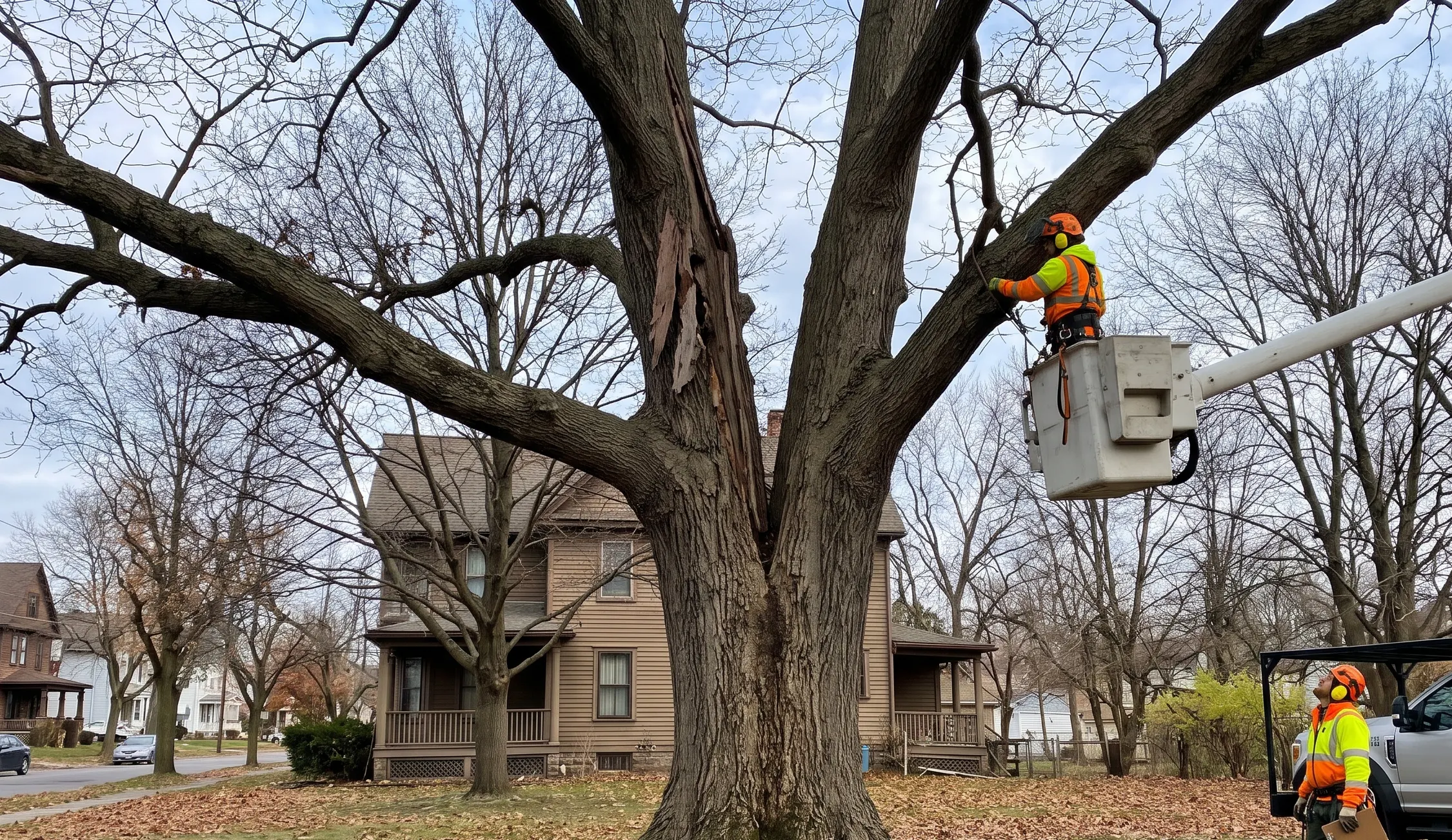
When a fierce November gale sweeps off Lake Erie and sends 60-mile-per-hour gusts rattling through Elmwood Village or North Buffalo, the loudest sound in your yard isn’t always a falling branch—sometimes it is the deep, unmistakable groan of a mature tree trunk tearing apart at the seam. Walking outside the next morning to find a vertical fissure running down the main union of a prized silver maple or red oak puts every Western New York homeowner in a tough spot. You do not want to lose a seventy-year-old shade tree that anchors your property, yet you cannot risk a multi-ton limb crashing onto your roof or across a neighbor’s driveway during the next winter squall. Understanding the structural mechanics behind tree cabling in Buffalo, NY versus complete tree removal allows you to make a calm, safety-first decision before the next wind warning hits Erie County.
Why Buffalo Winds Push Split-Trunk Trees to the Breaking Point
Western New York sits directly in the funnel of prevailing winds coming off the eastern basin of Lake Erie. Unlike brief summer thunderstorms that blow through in fifteen minutes, our autumn windstorms and heavy wet lake-effect snow events subject residential canopies to hours of sustained, rhythmic oscillation.
A healthy tree is engineered by nature to flex. Its wood fibers compress on the leeward side and stretch on the windward side, dissipating kinetic energy down into the root flare. However, when a tree develops structural defects early in its life, that energy concentrates at a single weak point instead of dispersing evenly.
Codominant Stems and Included Bark
Most trunk splits do not happen randomly in solid, single-stem timber. They occur in trees with codominant stems—two or more main trunks of roughly equal diameter growing upward from the same junction.
When two stems grow side by side at a tight, narrow angle (forming a sharp “V” rather than a wide, sturdy “U”), bark gets trapped between the expanding wood layers. Arborists call this included bark. Because bark cannot fuse together like living wood fibers do, the junction acts like a wooden wedge driven deeper into the crotch every year the tree adds girth. Add a gusty Buffalo windstorm or four inches of heavy, wet slush clinging to late-autumn leaves, and that V-shaped union peels apart like a wishbone.
Local Tree Species Most Vulnerable in Western New York
Across neighborhoods from Kenmore and Tonawanda down to Orchard Park and West Seneca, certain heritage species show up repeatedly on emergency storm calls:
- Silver Maples (Acer saccharinum): Fast-growing and abundant along older Buffalo streets, silver maples notoriously form multiple codominant leaders with brittle wood that splits easily under wind load.
- Bradford and Callery Pears: Commonly planted as street trees decades ago, these trees develop tightly clustered, weak branch attachments that routinely fail once they reach twenty-five to thirty years of age.
- Northern Red Oaks and Pin Oaks: While oak timber is remarkably strong, massive mature specimens with dual trunks carry tremendous canopy sail area, generating immense leverage during lakefront gales.
- Honey Locusts and Ash Trees: Aging specimens—especially ash trees weakened internally by past emerald ash borer damage—often suffer sudden longitudinal trunk splits when subjected to crosswinds.
Frequently Asked Questions
Why do trees seem to split more often in late autumn than in mid-winter in Buffalo?
In October and November, many mature oaks and maples still hold onto a large percentage of their leaves while Lake Erie produces strong gale-force winds and early wet snow. Leaves act like sails that catch the wind, multiplying the leverage placed on weak trunk junctions compared to bare winter branches.
Can young trees be pruned early so they never develop codominant stems?
Yes. Structural pruning during a tree’s first ten to fifteen years allows an arborist to subordinate competing leaders early, establishing a single dominant central trunk with wide, strong branch angles before included bark ever becomes a hazard.
What Is Tree Cabling and Bracing?
Cabling and bracing are supplemental structural support techniques governed by the ANSI A300 (Part 3) industry standards. Rather than “fixing” a tree the way a carpenter repairs a porch beam, structural support systems manage risk by limiting how far weak limbs or split stems can move independently during high winds.
How Cabling Works and Where Hardware Is Placed
Think of a split-trunk tree as two tall masts joined at a cracked hinge near the bottom. To stabilize both masts, arborists combine two complementary supports placed at different heights. High in the upper canopy—typically about two-thirds of the distance from the weak crotch to the outer branch tips—a high-tensile cable connects the two competing stems. When a wind gust pushes against one side of the crown, that cable transfers part of the load across to the opposite stem so neither leader can whip past its breaking threshold.
Arborists rely on two primary cabling systems depending on the tree’s condition:
- Static Steel Cabling Systems: Constructed from extra-high-strength (EHS) galvanized steel cable anchored into the wood with heavy-duty lag hooks, eye bolts, or through-bolts. Static systems allow minimal stretch and are the gold standard for trees that already show an active crack, severe included bark, or heavy decay.
- Dynamic Synthetic Cabling Systems: Made from UV-resistant, high-strength woven polyester or polypropylene hollow-braid ropes equipped with internal shock absorbers. Dynamic systems allow the stems to sway naturally in everyday breezes—which encourages the tree to keep building strong reaction wood—while catching the stems gently when extreme storm gusts hit.
The Role of Threaded Bracing Rods
When a trunk has already begun to split open, a cable high in the canopy is rarely enough on its own. If the bottom of the crack is still allowed to twist and grind in the wind, the wound will never seal, and decay fungi will rapidly colonize the exposed heartwood.
In these cases, an arborist installs one or more threaded steel bracing rods directly through the lower trunk just above and below the split. Washers and heavy nuts are countersunk into the outer bark so the tree can grow woundwood (callus tissue) cleanly over the hardware. Working as a unified system, the lower rigid steel rod stops lateral twisting right at the crack while the elevated cable absorbs sudden wind sway higher up in the crown.
Frequently Asked Questions
Does drilling steel bolts or rods into the trunk harm the tree?
Drilling clean, precision holes for eye bolts or threaded bracing rods causes minimal, localized trauma compared to the catastrophic damage of a trunk ripping in half. Within one to two growing seasons, a healthy tree compartmentalizes the drilled channel and forms thick, protective woundwood collars over the washers and nuts.
How long do tree cables last in Buffalo’s freeze-thaw climate?
High-tensile galvanized steel cables typically last 15 to 25 years in Western New York, while UV-stabilized synthetic dynamic cables generally have a service life of 8 to 12 years before replacement is recommended. Because trees continue growing taller and wider every year, an arborist should inspect the tension, hardware seating, and bark growth every 3 to 5 years—and after any severe wind event.
Side-by-Side Comparison: Tree Cabling vs. Complete Removal
Deciding between structural preservation and removal comes down to biology, physics, and target risk. Here is how the two paths compare for a residential property in the Buffalo area:
| Evaluation Factor | Structural Cabling & Bracing | Complete Tree Removal |
| Primary Objective | Reduce failure probability and extend the safe lifespan of a valuable tree. | Eliminate 100% of the structural hazard from the property permanently. |
| Condition of the Split | Fresh, clean longitudinal split; solid surrounding heartwood; minimal internal rot. | Deep, jagged split extending into the root flare; advanced fungal decay or hollow cavities. |
| Canopy Health | Full, vigorous foliage; healthy twig elongation; strong root anchorage. | Significant dieback in the upper crown; sparse foliage; root heaving or soil lifting at the base. |
| Target Risk Zone | Low-to-moderate consequence targets (open lawn, garden beds, secondary driveway). | High-consequence targets directly beneath (bedrooms, primary living areas, overhead utility drops). |
| Ongoing Maintenance | Requires annual visual checks and professional aerial inspections every 3 to 5 years. | Zero ongoing maintenance once the trunk and stump are cleared. |
| Property & Shade Impact | Preserves mature shade, cooling benefits, stormwater absorption, and curb appeal. | Immediate loss of canopy shade; opens the yard to sun and wind exposure until a replacement matures. |
| Upfront Investment | Significantly lower upfront cost than technical crane or sectional takedown. | Higher initial expense due to rigging, crew hours, hauling, and stump grinding. |
Frequently Asked Questions
Is cabling always cheaper than removing a large tree?
In almost all cases, yes. Installing a cabling and bracing system alongside selective crown pruning requires far less crew time, heavy equipment, and disposal hauling than dismantling a multi-ton mature tree piece by piece over a house or power lines.
Does homeowners insurance cover tree cabling or removal?
Standard homeowners policies generally do not cover preventive maintenance like cabling or routine pruning on an undamaged tree. However, if a sudden windstorm splits a tree and creates an immediate peril—or drops limbs onto a covered structure—many insurers cover emergency stabilization or removal up to policy limits. Always check your policy declarations and document storm damage immediately.
5 Clear Signs You Can Save a Split-Trunk Tree with Cabling
Not every cracked tree belongs in a woodchipper. When evaluated promptly by an experienced crew, many split-trunk trees recover remarkably well and stand safely for decades. Cabling and bracing are generally the right call when these five conditions align:
1. The Split Happened Recently and the Wood Is Sound
Time is your biggest enemy after a trunk splits. If a windstorm just opened a seam between two codominant leaders and the exposed interior wood is bright, firm, and free of spongy rot, bracing rods can draw the halves back together before airborne decay spores take hold. Once a crack has sat open for several seasons, rain, freeze-thaw cycles, and carpenter ants degrade the structural integrity needed to hold hardware securely.
2. Less Than One-Third of the Trunk Circumference Is Compromised
Arborists look closely at how much sound, load-bearing sapwood remains intact around the tree’s perimeter. Even if a V-shaped crotch splits down a couple of feet, if the remaining outer shell of living wood is thick and continuous—and the split has not progressed down to ground level—the tree retains enough biological strength to support cables and generate reinforcing wound wood.
3. The Root System Is Firmly Anchored
Cabling redistributes wind stress between upper limbs, but every ounce of that force still travels down into the soil. Before installing a single bolt, an arborist inspects the base of the tree for root heave—mounded soil, cracked turf, or lifted roots on the windward side. If the root plate is rock-solid and free of root-rot fungi (such as Ganoderma or Armillaria brackets growing near the flare), the tree has the foundation required for upper-crown support.
4. Crown Reduction Pruning Can Lighten the Sail Load
Cabling is rarely a standalone fix; it works best paired with selective crown thinning or end-weight reduction. By trimming back overextended outer tips by 10% to 15%, an arborist drastically reduces the leverage (torque) that a 55-mph gust exerts on the repaired trunk union—without resorting to destructive “topping,” which triggers weak water sprouts and starves the tree.
5. The Tree Holds High Ecological or Property Value
A mature sugar maple, white oak, or American beech can take forty to sixty years to replace. Beyond boosting residential property values, mature trees in Buffalo neighborhoods buffer winter winds, reduce summer air-conditioning loads, and absorb thousands of gallons of stormwater runoff. When the structural math checks out, preserving a healthy specimen protects an asset you simply cannot buy at a nursery.
Frequently Asked Questions
Will a split trunk eventually grow back together into solid wood?
Tree wood does not “heal” like human bone; the original split interior heartwood will never fuse back into solid timber. Instead, bracing rods hold the stems immobile so the outer cambium layer can grow continuous new rings of strong woundwood across the seam, permanently encasing the defect over time.
Can you cable a tree that has already split wide open?
Yes, provided the split happened recently, the interior wood has not rotted, and the crack does not extend into the root flare. Using specialized come-alongs and rigging, arborists carefully draw the separated stems back to their natural alignment, secure them with threaded bracing rods, install an upper support cable, and prune outer limb tips to reduce wind leverage.
5 Warning Signs When Removal Is the Only Safe Option
Honest arboriculture means knowing when hardware cannot outsmart gravity. Installing cables into compromised wood creates a false sense of security and leaves homeowners liable if the tree fails during a storm. Full removal is the responsible recommendation when any of the following red flags appear:
1. Extensive Internal Decay or Hollow Cavities
Steel eye bolts and threaded rods rely on dense, healthy wood fibers to grip against extreme tension. If sounding the trunk with a mallet reveals a hollow drum-like echo, or if probe tests uncover soft, punky heartwood inside the split, hardware will simply pull straight through the softened fibers during the first heavy gale.
2. The Split Extends Into the Root Flare or Ground Line
When a vertical crack runs all the way down through the base of the trunk and into the buttress roots, the tree has lost its foundational hinge. No configuration of upper-canopy cables or lower bracing rods can stop a root-split trunk from twisting off its base under lateral wind pressure.
3. Severe Lean Combined with Soil Heaving
If a split-trunk tree has suddenly developed a noticeable lean after a storm—accompanied by fresh gaps in the soil on one side of the trunk and buckled earth on the other—the root system is actively failing. Attempting to cable a tree that is uprooting is unsafe for climbers and ineffective for the homeowner.
4. Fungal Fruiting Bodies Along the Trunk or Base
Mushrooms, conks, or shelf fungi emerging directly from the bark along the split or around the root collar are the reproductive structures of wood-decay organisms that have already been digesting the tree’s structural cellulose and lignin from the inside out for years. By the time conks appear externally, internal strength loss is usually far too advanced for cabling.
5. High-Value Targets with Zero Margin for Error
Even well-engineered cabling systems reduce risk—they do not eliminate it entirely. If a massive, partially decayed split oak hangs directly over a child’s bedroom, a busy public sidewalk, or high-voltage primary power lines, the consequence of a catastrophic failure outweighs the benefit of preservation.
Frequently Asked Questions
How can I tell on my own if the base of my tree is failing?
Walk around the base of the trunk and look closely at the soil line. Freshly cracked turf, exposed pale roots that were previously underground, or a mound of lifted soil on the side opposite the tree’s lean are urgent warning signs of root plate failure that require immediate removal.
Why shouldn’t an arborist just remove the split half of the tree and leave the standing half?
Removing an entire codominant leader leaves a massive vertical wound down the main trunk that the tree can rarely seal before decay sets in, while suddenly exposing the remaining half to full wind loads it was never adapted to handle alone. In most cases, removing half of a mature codominant tree leads to total failure within a few years.
How to Perform a Safe Ground-Level Check Before Calling an Arborist
Before an arborist arrives on site, you can run through a simple three-part ground check from a safe distance to understand what kind of urgency you are dealing with.
First, examine the ground and root flare at the bottom of the tree. If you notice soil lifting, fresh earth cracks, or roots pulling out of the lawn, the tree’s foundation is compromised and immediate removal is almost always necessary. Second, look closely at the interior of the trunk crack itself. If the exposed wood is dark, wet, crumbly, or filled with insect galleries and fungal conks, steel hardware will not hold reliably, making removal the safer route. Third, look upward to evaluate the overall canopy vitality. If the tree is firmly rooted, the interior split wood is solid, and more than half of the crown carries healthy, vigorous branches, the tree is typically a strong candidate for structural cabling, bracing, and crown weight reduction.
What to Do Immediately After Discovering a Split Trunk
If you step outside after a storm and spot a fresh split in one of your trees, taking the right steps in the first twenty-four hours protects both your family and the tree’s chances of survival:
- Establish a Clear Safety Perimeter: Keep family members, pets, and vehicles well away from the drop zone beneath the split stem. If a cracked limb is leaning toward your house, avoid using rooms directly beneath that section of the roof until an arborist inspects the load.
- Watch for Overhead Power Lines: Never approach a split tree if branches are resting on or tangled near electrical lines. Even if a line looks insulated, treat it as energized and contact National Grid or NYSEG alongside emergency tree responders.
- Do Not Use Ratchet Straps or Hardware-Store Wire: Homeowners occasionally wrap nylon cargo straps or thin fencing wire around a split trunk, hoping to pull it shut. Under wind load, improvised straps snap violently, girdle the living bark (cutting off nutrient flow), and provide zero structural protection.
- Document the Damage for Insurance: Take clear, wide-angle, and close-up photos of the split, the canopy, and any property contact from a safe distance before any emergency mitigation begins.
- Schedule an On-Site Structural Evaluation: A tree’s true stability cannot be judged from a single smartphone photo. An experienced arborist needs to inspect the union angle, test wood density, evaluate wind exposure, and check attachment points aloft.
Frequently Asked Questions
Why are ratchet straps or chains wrapped around a trunk dangerous?
Wrapping straps, chains, or wire around the outside of a tree trunk squeezes the living cambium layer just beneath the bark, strangling the tree’s water and nutrient transport system. Worse, under severe wind gusts, nylon straps stretch and snap back violently without preventing the wood fibers inside from tearing apart.
How quickly after a storm does a split trunk need to be cabled?
Ideally within a few days to two weeks of the split occurring. Acting quickly keeps the exposed wood clean, prevents moisture from freezing and expanding inside the crack, and allows bracing rods to pull the separated sections snug before the wood warps.
Looking for Emergency Tree Cabling or Storm Tree Removal Near Me in Buffalo?
When a windstorm leaves a split trunk hanging over your garage or driveway, searching for “tree cabling near me“ or “emergency tree removal near me“ isn’t about browsing out-of-town directories—you need a local crew with heavy rigging gear already staged in Erie County. Because our equipment yard is located right off I-190 and Clinton Street at 332 Cable St in Buffalo (14206), our climbers and bucket trucks dispatch rapidly across the city and surrounding suburbs without long travel delays.
We regularly perform structural cabling, bracing, crown weight reduction, and technical removals across:
- City of Buffalo Neighborhoods: Elmwood Village, North Buffalo, Hertel Avenue, Parkside, Allentown, South Buffalo, Kaisertown, and Riverside (14206, 14207, 14213, 14214, 14216, 14220, 14222).
- Northern & Eastern Suburbs: Amherst, Williamsville, Snyder, Eggertsville, Kenmore, Tonawanda, Cheektowaga, and Lancaster (14215, 14217, 14221, 14223, 14225, 14226, 14086).
- Southtowns & Lakefront Communities: West Seneca, Orchard Park, Lackawanna, Hamburg, and Blasdell (14218, 14219, 14224, 14127, 14075)—areas that bear the brunt of direct Lake Erie wind gusts.
Frequently Asked Questions
How fast can Skyline Tree Care inspect a split tree near me in Erie County?
For urgent storm-split trunks threatening a home, driveway, or utility line, we offer 24/7 emergency dispatch across Buffalo and nearby suburbs. For non-emergency preventive cabling assessments, we typically schedule on-site inspections within 24 to 48 hours.
Do Buffalo or Amherst homeowners need a permit to cable or remove a split tree?
On private residential property, structural cabling and pruning do not require a city permit. If a hazardous split tree sits within the public street right-of-way (the grass strip between the sidewalk and curb) in Buffalo, Amherst, or Kenmore, municipal forestry rules apply—our team helps you verify property boundaries before work begins.
Why Buffalo Homeowners Trust Skyline Tree Care for Structural Assessments
When a split trunk threatens your home, you need straight answers—not a sales pitch pushing unnecessary removal when a tree can be safely preserved, and never a risky patch job on a tree that genuinely needs to come down. At Skyline Tree Care, our crew approaches every storm-damaged or structurally compromised tree with rigorous field experience and strict adherence to ANSI A300 cabling, bracing, and pruning standards.
Operating right out of our yard at 332 Cable St in Buffalo, NY, we understand firsthand how Lake Erie winds, freeze-thaw cycles, and heavy wet snow test local maples, oaks, and street trees across Erie County. Whether your property needs precision static or dynamic cabling, threaded bracing rods, selective crown weight reduction, or safe technical removal with full stump extraction, we walk you through every option clearly before a single saw starts.
Get a Professional Assessment & Find Our Buffalo Yard
Do not wait for the next gale warning to find out whether that crack in your trunk will hold. Reach out to Skyline Tree Care today for an honest, on-site inspection and free estimate:
Frequently Asked Questions
Do you offer 24/7 emergency response if a split trunk threatens our house overnight?
Yes. Skyline Tree Care provides 24/7 emergency storm response across Buffalo and surrounding Erie County communities to stabilize hazardous limbs, relieve roof loads, or perform urgent takedowns when severe weather strikes.
Can you inspect previously cabled trees installed by another company?
Yes. If you moved into a Buffalo home with existing cables or bracing rods in mature yard trees, our team can inspect the hardware tension, check for bark overgrowth or corrosion, and recommend any necessary maintenance updates.