
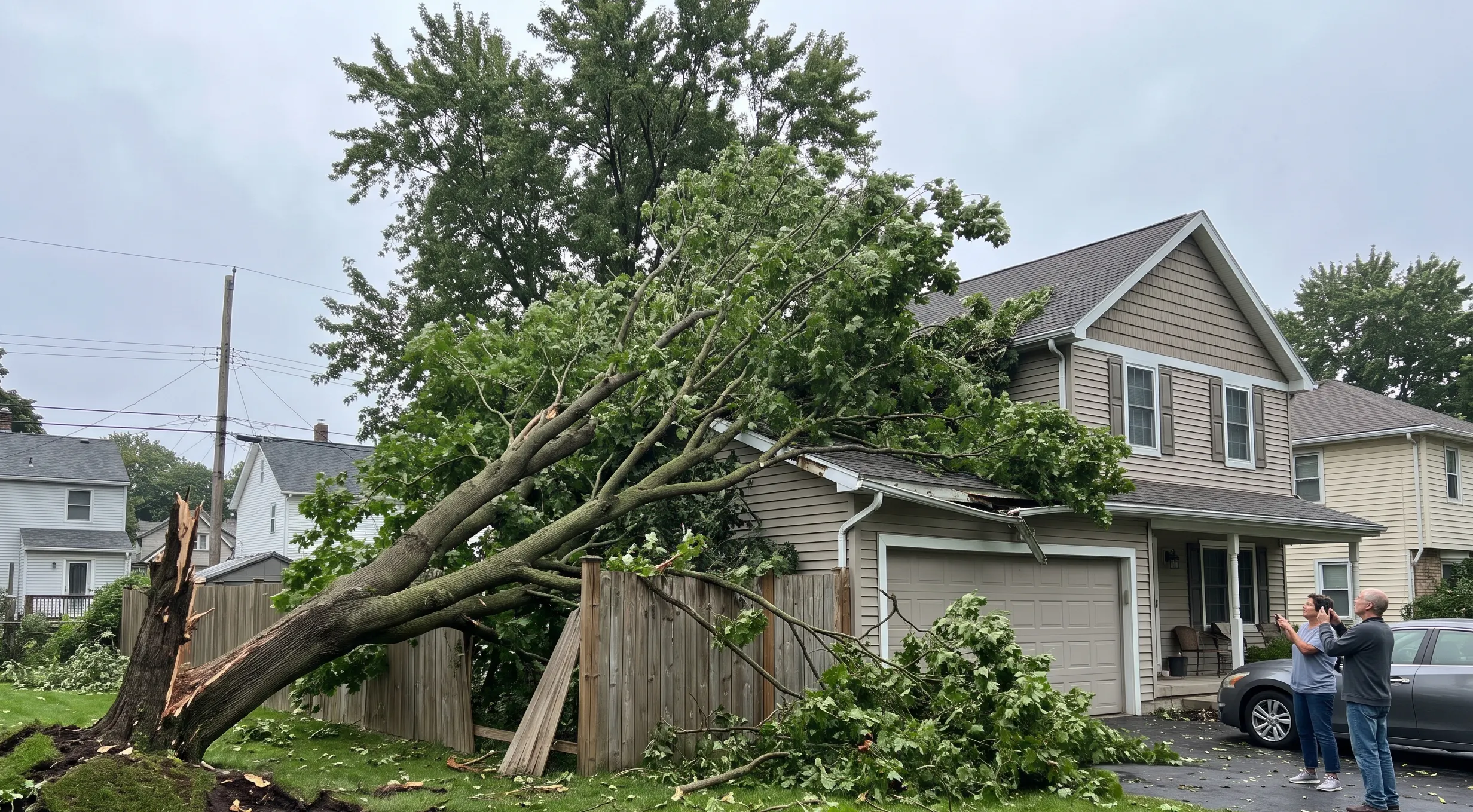
Living in Western New York means appreciating the beauty of mature oaks, towering maples, and lush silver birches that shade our neighborhoods from Elmwood Village to Amherst. However, those same towering canopies come with real risks when lake-effect storms, heavy wet snow, or sixty-mile-per-hour winds sweep off Lake Erie. If a massive limb or an entire trunk from next door suddenly crashes onto your garage, crushes your cedar fence, or blocks your driveway, your first reaction is shock—quickly followed by a pressing financial question: Who is going to pay for this? Navigating insurance claims, state liability rules, and urgent tree removal in Buffalo, NY can feel overwhelming when you are staring at thousands of pounds of tangled timber in your yard.
At Skyline Tree Care, our crews respond to storm emergencies across Erie and Niagara counties every single week. While we are experienced tree care specialists—not licensed attorneys—we have worked alongside hundreds of local homeowners, insurance adjusters, and property managers dealing with fallen boundary trees. Understanding how New York State law views tree ownership, negligence, and homeowners insurance will save you from costly mistakes, awkward neighborhood disputes, and unexpected out-of-pocket bills.
The Short Answer: How New York State Law Assigns Responsibility
If you want the quick takeaway before diving into the legal and insurance nuances, here is the general rule in New York State: In most cases, your own homeowners insurance pays for damage to your property—even if the tree was rooted entirely in your neighbor’s yard.
That answer surprises almost everyone. Instinctively, most homeowners assume that because a tree belongs to the person whose land it grows on, that owner is automatically responsible for anything the tree hits. Under New York property and negligence law, however, ownership alone does not equal financial liability. Instead, New York courts and insurance carriers look closely at why the tree fell and what the tree’s owner knew before the incident occurred.
Scenario 1: A Healthy Tree Falls During a Storm (“Act of Nature”)
Suppose your neighbor has a vigorous, healthy sugar maple. In November, a fierce windstorm barrels across Buffalo, snapping the trunk and sending the upper canopy straight onto your roof. Because the tree showed no outward signs of disease or structural failure prior to the storm, New York law classifies the event as an unavoidable “Act of Nature” (often referred to in insurance policies as an “Act of God”).
In this situation:
- Your neighbor is not legally negligent.
- You must file a claim with your own homeowners insurance carrier to repair your roof and cover debris haul-away.
- You will be responsible for paying your own policy deductible.
Scenario 2: A Dead, Diseased, or Hazardous Tree Falls (Negligence)
The financial equation flips completely if the tree was visibly dead, rotting, hollow, or dangerously leaning before it came down, and your neighbor failed to take reasonable steps to address the hazard. Under New York negligence standards, property owners have a duty of reasonable care to prevent known hazards on their land from harming neighboring properties.
If you can establish that your neighbor knew—or reasonably should have known—that the tree posed a danger, your neighbor (and their homeowners’ liability insurance) can be held financially liable for:
- Structural repairs to your house, garage, or shed
- Full debris cleanup and hauling costs
- Reimbursement of your insurance deductible through a process called subrogation
Frequently Asked Questions
Does my neighbor automatically have to pay just because the trunk grew in their yard?
No. In New York State, tree ownership alone does not make a property owner strictly liable for storm damage. Unless there is proof of prior negligence or a known hazard, each homeowner’s own policy handles damage to their respective property.
Will filing a storm claim on my own homeowners insurance raise my rates?
While any claim goes onto your Comprehensive Loss Underwriting Exchange (CLUE) report, weather-related “Act of Nature” claims are generally viewed differently by New York insurers than preventable liability claims. Check with your local insurance agent before filing if the damage is only slightly above your deductible.
What if only part of the tree fell into my yard, while the rest is still standing next door?
You and your insurer are typically responsible for clearing the fallen portion on your side of the property line. However, your neighbor remains responsible for the standing portion in their yard—especially if the split trunk now poses an immediate danger of falling toward your home.
Actual Notice vs. Constructive Notice: The Heart of New York Tree Liability
When an insurance adjuster or a New York court evaluates whether a tree owner was negligent, the entire case usually hinges on one legal concept: notice. To hold a neighbor financially responsible, there must be evidence of either actual notice or constructive notice.
What Is Actual Notice?
Actual notice means the tree owner had direct, explicit knowledge that the tree was compromised or hazardous. Examples of actual notice include
- Written warnings from you: A text message, email, or certified letter you sent months earlier pointing out dead upper limbs, deep trunk cracks, or a worsening lean toward your house.
- A prior arborist evaluation: An inspection report from a tree service noting decay, root rot, or structural instability that the owner chose to ignore.
- Municipal code violations: A notice from the City of Buffalo or a local town code enforcement officer citing a hazardous tree on the property.
What Is Constructive Notice?
Even if nobody ever sent a formal warning, a tree owner can still be held liable under constructive notice. Constructive notice applies when a dangerous defect was so obvious and visible over a significant period that a reasonably attentive homeowner should have discovered it.
Signs that often support constructive notice include:
- A tree that has been completely leafless throughout the spring and summer growing seasons
- Large shelf fungi (conks) or mushrooms growing directly out of the bark or root flare, which signal advanced internal wood decay
- Massive, hollowed-out cavities in the main trunk
- Uprooting soil or heaving ground around the base of the tree
On the flip side, if a tree appeared completely healthy on the outside and only revealed hidden internal rot after snapping in half during a gale, constructive notice is very difficult to prove. Insurers do not expect everyday homeowners to possess X-ray vision or perform invasive core drilling on trees that look healthy.
Frequently Asked Questions
Is a verbal conversation over the backyard fence enough to prove actual notice?
Verbal warnings are notoriously hard to prove if a dispute ends up with insurance adjusters or attorneys. People remember conversations differently months later. Always follow up with a friendly in-person chat with a dated text message or email so you have a clear timestamped record.
If the fallen trunk looks hollow on the inside now, doesn’t that automatically prove my neighbor was negligent?
Not necessarily. Many older maples and oaks develop internal heartwood rot while maintaining a thick, green, healthy-looking outer canopy. Unless there were outward warning signs—like large open cavities, dead crown branches, or fungal brackets on the bark—insurers usually still treat the failure as an unforeseeable event.
How long does a neighbor have to fix a hazardous tree after receiving notice?
New York law looks at whether the owner had a “reasonable opportunity to act” between learning of the hazard and the date the tree fell. If you warned your neighbor two days before a hurricane, they likely did not have enough time to hire a crew; if you warned them six months ago and they did nothing, negligence is much easier to establish.
What Homeowners Insurance Actually Covers (And What It Doesn’t)
Even when your own homeowners policy steps in to cover storm damage, many Western New York residents are caught off guard by policy caps, exclusions, and fine print. Homeowners policies do not treat every fallen tree the same way; coverage depends heavily on what the tree landed on.
1. The Tree Hits a Covered Structure
If a neighbor’s tree lands on your house, attached garage, detached shed, or fence, your policy’s dwelling or “other structures” coverage generally pays to repair the physical damage (minus your deductible). In addition, your insurer will pay for the reasonable cost of cutting the tree off the structure and hauling the debris away. Keep in mind that most standard policies place a sublimit on tree debris removal—often between $500 and $1,000 per tree or per storm event. If a massive, 80-foot cottonwood requires a crane to lift it safely off your roof, the portion of the bill exceeding that debris sublimit may come out of pocket unless your policy includes an extended endorsement.
2. The Tree Lands on Your Open Lawn Without Hitting Anything
This is the scenario that frustrates homeowners the most. Suppose a huge oak from next door crashes directly down the middle of your backyard, flattening your lawn and blocking your patio, yet miraculously misses your house, fence, and shed.
In nearly every standard homeowners policy, if a fallen tree does not damage a covered structure, insurance pays $0 for tree cleanup. The sole exception found in some policies is if the fallen tree blocks a driveway used by a motor vehicle or obstructs a ramp designed for a person with a disability. Otherwise, if a healthy tree lands strictly on grass or landscaping, paying a crew to buck, chip, and haul the wood falls entirely on your shoulders.
3. The Tree Crushes Your Car in the Driveway
If a neighbor’s tree falls on your parked vehicle, do not call your homeowners insurance company—call your auto insurance carrier. Falling objects, including tree limbs and entire trunks, are covered under the comprehensive portion of your auto policy (subject to your auto deductible). If you only carry state-minimum liability auto coverage without comprehensive protection, your insurer will not pay to repair or replace the vehicle.
4. Boundary Line Trees (“Line Trees”)
What happens when a tree trunk sits directly on the property line, with half the trunk in your yard and half in your neighbor’s? Under New York law, a tree whose trunk straddles a boundary line is owned jointly as tenants in common. Neither neighbor has the right to cut down or severely injure a healthy boundary tree without the other owner’s consent. If a boundary tree falls, both owners share responsibility for its maintenance and potential liability, making clear communication and shared documentation essential.
Frequently Asked Questions
What if the tree crushed my patio furniture, grill, or above-ground pool?
Personal property (like patio furniture and grills) is typically covered under Coverage C of your homeowners policy if damaged by a falling object, subject to your deductible. Above-ground pools and sheds generally fall under “Other Structures” (Coverage B), though policy exclusions vary—always confirm with your adjuster.
Does homeowners insurance pay for stump grinding after a neighbor’s tree uproots?
Generally, no. Even when insurance pays to lift a tree off your roof and haul the trunk away, standard policies rarely cover grinding a remaining stump in the ground unless the stump itself is obstructing a covered structure or driveway access. If you need the root plate cleared afterward, check our stump grinding services in Buffalo for transparent pricing.
Can I ask my neighbor to split the cost if a healthy tree lands only on my lawn?
Legally, your neighbor is not required to contribute if the tree was healthy. However, in friendly Western New York neighborhoods, neighbors frequently agree to split a local tree service bill 50/50 out of goodwill—especially when the trunk spans both yards.
Understanding Your Right to Trim Overhanging Branches in New York
Many Buffalo homeowners try to prevent storm damage before it happens by trimming branches that reach across their fence line. Under New York’s long-standing “self-help” rule, you have the legal right to prune branches and roots from a neighbor’s tree that encroach onto your property—strictly up to the property line.
However, exercising this right comes with strict legal guardrails:
- You cannot trespass: Unless your neighbor gives you explicit permission, you (and any tree crew you hire) must perform all pruning work from your side of the property line.
- You cannot kill or destabilize the tree: If aggressive over-pruning causes the neighbor’s tree to die, become diseased, or lose structural balance, you can be sued for damages. Under New York Real Property Actions and Proceedings Law (RPAPL § 861), wrongfully destroying or injuring someone else’s timber can even expose you to treble (triple) damages.
- You pay for routine maintenance trimming: If you simply want overhanging branches trimmed for sunlight, clearance over your roof, or to keep leaves out of your gutters, you are responsible for hiring and paying a qualified crew for professional tree trimming and pruning.
Frequently Asked Questions
Do I need my neighbor’s permission before trimming branches hanging over my roof?
As long as the trunk is wholly on your neighbor’s property and your tree crew stays strictly on your side of the boundary line without harming the tree’s overall health, New York law allows you to trim encroaching branches without formal permission. Giving your neighbor a courteous heads-up beforehand, however, always helps keep the peace.
Can I keep or sell the firewood from branches I cut off on my side of the fence?
Under common law principles, the wood from a neighbor’s tree technically belongs to the tree’s owner. While most neighbors are grateful you cleared the branches and won’t want the brush, it is good practice to ask whether they want the cut wood before disposing of it.
What if overhanging branches are dead and actively dropping onto my deck?
If overhanging limbs are visibly dead or hazardous, notify your neighbor in writing first and request that they address the hazard. If they refuse and the dead limbs pose an imminent risk, you can prune back to the property line at your own expense or consult an attorney regarding nuisance abatement.
Step-by-Step Guide: What to Do Immediately After a Neighbor’s Tree Falls
When a tree comes down on your property, the actions you take in the first few hours can make or break your insurance claim and protect your family from severe injury. Follow this practical checklist:
Step 1: Prioritize Life Safety and Check for Downed Wires
Before stepping outside to inspect the damage, look carefully through your windows for downed power lines, utility drops, or sparking cables tangled in the branches. In older Buffalo neighborhoods with overhead rear-yard utility easements, falling limbs frequently pull live wires down with them. Assume every downed wire is energized and lethal. Keep children and pets indoors, call 911 if there is an immediate hazard, and contact National Grid or NYSEG to de-energize the line before anyone approaches the tree.
Step 2: Document Everything Thoroughly Before Cutting a Single Branch
Insurance adjusters rely on visual evidence. Before a cleanup crew clears the scene, take extensive photos and videos from a safe distance:
- Photograph the entire scene showing where the tree stood in your neighbor’s yard and where it landed on yours.
- Take close-up shots of the broken trunk base, root plate, and any visible decay, hollow cavities, fungus, or pest damage.
- Capture every angle of structural damage to your roof, gutters, siding, fence, or vehicle.
- Gather any prior texts, emails, or photos showing you warned your neighbor about the tree’s condition.
Step 3: Contact Your Homeowners Insurance Company
Report the incident promptly and stick strictly to observable facts. Let your adjuster know whether the tree struck a covered structure or is blocking your driveway, and ask about your debris removal coverage limits and emergency mitigation rules. Most policies require homeowners to take reasonable steps to prevent further damage—such as tarping a punctured roof—and will reimburse reasonable emergency stabilization expenses.
Step 4: Hire an Insured, Local Tree Professional for Safe Extraction
Removing a storm-damaged tree resting on a roof or tangled under tension is among the most dangerous tasks in arboriculture. A single misplaced chainsaw cut can release thousands of pounds of stored spring tension or send a heavy log rolling straight through your ceiling rafters. Always hire a local company carrying full general liability and workers’ compensation insurance and ask for a detailed, itemized invoice separating structural extraction from general yard debris cleanup—adjusters require that breakdown to process your claim smoothly.
Frequently Asked Questions
Should I wait for the insurance adjuster to visit in person before removing the tree off my roof?
No. Standard homeowners policies require you to mitigate further damage (such as rain entering a breached roof). Take clear photos and videos from multiple angles first, call your insurer to report the emergency, and have an insured crew safely lift the tree off the structure and tarp the opening.
Why does my tree service invoice need to separate “structural removal” from “debris haul-away”?
Insurance policies often pay the full cost of lifting a tree off a damaged house under dwelling coverage, while capping the cost of cutting up and hauling away the wood under a separate debris removal sublimit. An itemized invoice ensures you receive every dollar your policy owes you.
Can my tree crew enter my neighbor’s yard to remove the base of the fallen tree?
Not without your neighbor’s explicit permission. Even after a storm, entering a neighbor’s property or operating equipment on their lawn without consent constitutes trespass.
How Western New York Weather Creates Unique Boundary Tree Risks
Operating out of our yard on Cable Street in Buffalo gives our crew a front-row seat to the specific environmental stresses that topple trees across Erie County. Unlike regions with mild winters, Western New York trees endure a punishing seasonal cycle:
- Early Autumn Wet Snowstorms: When heavy, wet lake-effect snow arrives in October or November while deciduous trees still hold their leaves, the added weight on upper canopies can increase branch load by hundreds of percent. Silver maples, boxelders, and weeping willows are notoriously prone to splitting under early snow loads.
- Saturated Spring Clay Soils: Much of Buffalo, Cheektowaga, West Seneca, and Tonawanda sits on dense, poorly draining clay soil. When heavy spring rains saturate the ground and 50 mph gusts blow off Lake Erie, shallow-rooted trees can uproot completely—lifting entire root balls intact out of the yard and tipping straight onto neighboring homes.
- Invasive Pests and Fungal Decline: Emerald Ash Borer has devastated ash populations across Western New York over the past decade. Dead standing ash trees become dangerously brittle within two to three years of infestation, shedding massive limbs even on calm days. Similarly, aging Norway maples and oaks weakened by oak wilt or carpenter ants often fail unexpectedly during summer thunderstorms.
Recognizing these local warning signs early allows homeowners to address hazardous trees proactively—before a storm turns a routine maintenance issue into a five-figure insurance battle.
Frequently Asked Questions
Which tree species in Buffalo are most likely to fail during wind or snowstorms?
Silver maples, weeping willows, Bradford pears, cottonwoods, and EAB-damaged green or white ash trees have the highest failure rates across Erie County due to weak branch unions, brittle wood, or shallow root systems.
How can I tell if my neighbor’s ash tree is dead from Emerald Ash Borer?
Look for thinning foliage at the very top of the crown, D-shaped exit holes in the bark, vertical bark splitting, and extensive woodpecker feeding (“blonding” of the bark). Dead ash trees lose structural integrity rapidly and should be evaluated promptly.
Does saturated ground make healthy trees fall over without snapping?
Yes. During wet spring thaw cycles in Western New York, heavy clay soils lose their grip on root plates. Even a structurally sound tree can tip over at the roots during a strong Lake Erie wind event—which insurers still classify as an Act of Nature.
How Subrogation Helps You Recover Your Deductible
If you had to file a claim on your own homeowners policy because a neighbor’s visibly dead tree smashed your garage, you do not necessarily have to eat your $1,000 or $2,500 deductible forever. Provide your insurance adjuster with all of your evidence of negligence—prior text messages, dated photos of the dead tree, or an arborist’s assessment.
Once your insurer pays to repair your home, their legal team can initiate subrogation against your neighbor’s homeowners insurance company. During subrogation, your insurer seeks reimbursement from the at-fault party’s carrier. If they successfully prove your neighbor had actual or constructive notice of the hazardous tree, your insurer recovers what they paid out—and typically refunds your deductible to you.
Frequently Asked Questions
How long does the subrogation process usually take in New York?
Subrogation happens behind the scenes between insurance carriers after your home repairs are underway or completed. Depending on how disputed the evidence is, it can take anywhere from a few months to over a year before your deductible is refunded.
Do I have to hire my own lawyer for my insurer to pursue subrogation?
No. When you file through your own homeowners policy, your insurance company uses its own subrogation specialists and legal counsel to pursue recovery from your neighbor’s carrier at no direct legal cost to you.
What if my neighbor didn’t have homeowners insurance when their dead tree fell?
If your neighbor is uninsured and was clearly negligent, your own insurer will still cover your structural repairs (minus your deductible). To recover your deductible or uninsured losses directly from an uninsured neighbor, you would need to pursue a claim in small claims court or civil court.
Finding Fast, Insured Emergency Tree Removal Near You in Buffalo & Erie County
When a neighbor’s limb is resting on your roof or blocking your driveway after a Lake Erie windstorm, searching for reliable tree removal near me isn’t about finding the cheapest out-of-town storm chaser—it’s about getting a fully insured local crew on-site fast before rain or wind causes secondary structural damage.
Because Skyline Tree Care operates directly out of our equipment yard at 332 Cable St in Buffalo (14206), our bucket trucks, grapple loaders, and cranes are positioned minutes from major Erie County arteries, including the I-190, I-90, Route 33, and Route 219. That central dispatch location allows our crews to reach residential properties quickly across:
- City of Buffalo Neighborhoods: Elmwood Village, North Buffalo, Hertel Avenue, Parkside, South Buffalo, Kaisertown, Lovejoy, Riverside, and Allentown (14201–14222)
- First-Ring & Southtowns Suburbs: Cheektowaga, West Seneca, Orchard Park, Lackawanna, Hamburg, and East Aurora
- Northtowns Communities: Amherst, Williamsville, Snyder, Eggertsville, Tonawanda, Kenmore, and Clarence
Whether you need an urgent crane extraction off a pitched roof, an insurance-ready written assessment for a hazardous boundary tree, or complete storm debris haul-away in your neighborhood, our 24/7 emergency tree service team is nearby and ready to dispatch.
Frequently Asked Questions
How fast can Skyline Tree Care reach my home during a Buffalo storm emergency?
Because our trucks are stationed centrally on Cable Street near the I-190 and I-90, our emergency response crews typically reach homes anywhere in Buffalo, Cheektowaga, West Seneca, or Amherst within 60 to 90 minutes for active structural hazards.
Do you provide written tree hazard evaluations I can share with my neighbor or insurance adjuster?
Yes. Our field supervisors can inspect leaning, dead, or storm-damaged boundary trees and provide clear written documentation and itemized estimates suitable for homeowners insurance claims.
Are your crews insured to work near roofs, fences, and tight Buffalo city lots?
Yes. Skyline Tree Care carries comprehensive General Liability and New York Workers’ Compensation insurance, and we use specialized compact lifts and rigging techniques designed specifically for narrow urban driveways and tightly spaced city lots.
Need Help With a Storm-Damaged or Hazardous Tree in Western New York?
Whether you are dealing with an urgent tree emergency after a Lake Erie windstorm or want a professional assessment of a questionable boundary tree before severe weather hits, Skyline Tree Care is ready to help. Our experienced local crew provides safe, fully insured crane-assisted removals, technical rigging, structural pruning, and complete stump extraction across Buffalo and Western New York.