
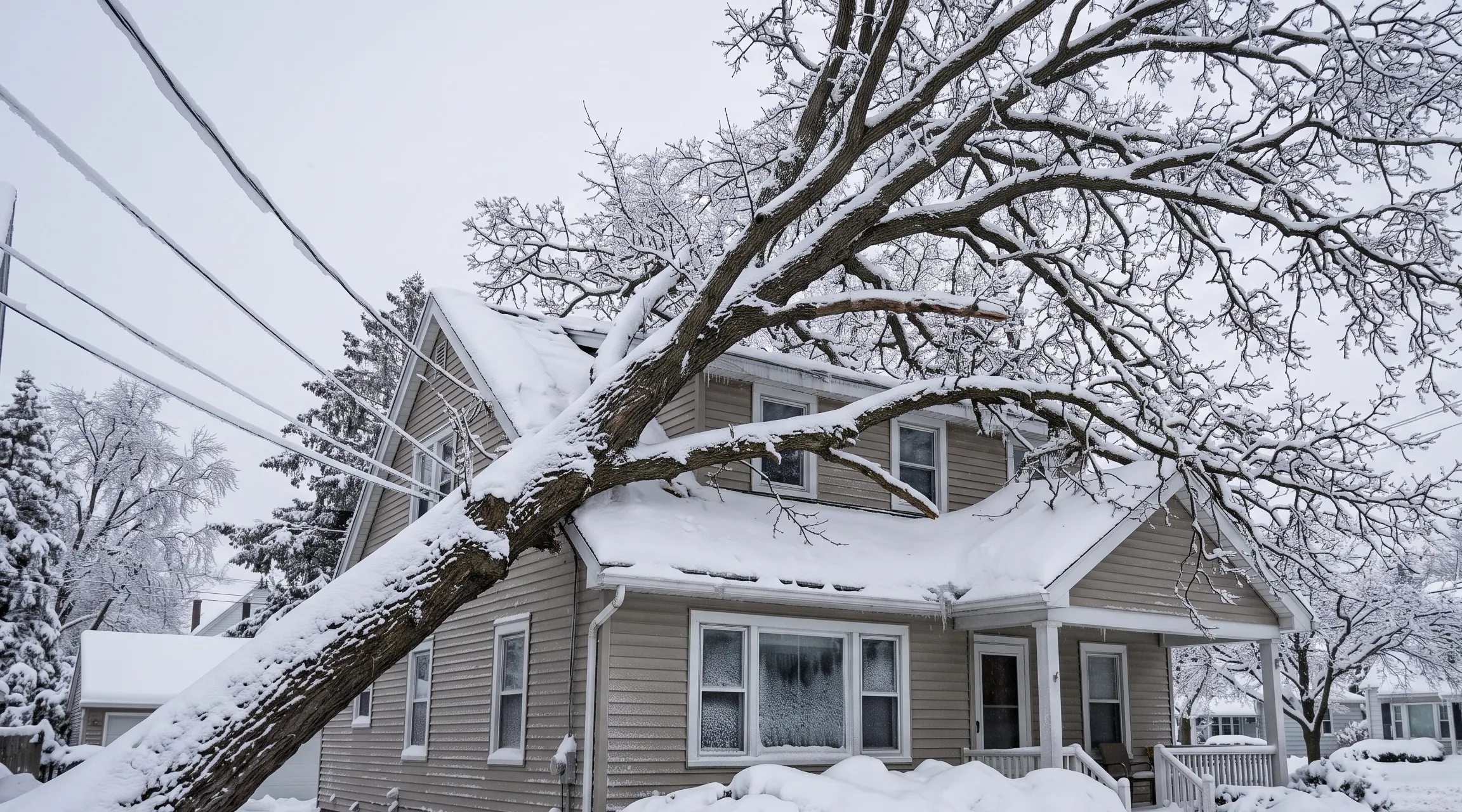
Waking up after a Western New York lake-effect storm only to discover a mature hardwood listing dangerously over your rafters is a homeowner’s worst nightmare. If you have a tree leaning over your roof after a blizzard, acting quickly and deliberately is critical to protect your family, minimize structural damage, and preserve your insurance coverage. Between heavy lake-effect snow loads, sub-zero gale gusts coming off Lake Erie, and saturated frost-heaved soil, trees in Buffalo face extreme mechanical stress every winter. Before you step outside or grab a ladder, you need to understand the immediate hazards, know who to call for professional emergency tree service, and follow a clear, arborist-backed safety protocol.
1. Immediate Safety Protocols: What to Do in the First 10 Minutes
When a multi-ton oak, maple, or pine is bearing down toward your roof decking, personal safety must always take priority over property preservation. Structural collapses happen suddenly, especially when temperatures fluctuate or aftershocks of wind buffet an already compromised root plate.
Evacuate the Impact Zone Immediately
- Clear Upper Levels: If the tree is actively resting on the roof structure, cracking structural drywall, or bulging plaster ceilings, leave the house entirely and contact our residential emergency tree removal service in Buffalo for urgent structural shoring and crane extraction before entering the premises again.
- Move Downstairs or Out: Move your family and pets to the opposite end of the home on the ground floor. If the tree is actively resting on the roof structure, cracking structural drywall, or bulging plaster ceilings, leave the house entirely and seek shelter with neighbors or in your vehicle.
- Keep Off the Roof: Never climb onto the roof to inspect the damage, shovel away snow, or attempt to cut branches yourself. Adding human weight to an overloaded, structurally compromised roof deck can trigger immediate failure.
Stay Alert for Downed Utility Lines
Blizzards regularly knock tree crowns into residential service drops. Treat any wire touching or near the leaning tree as an energized, live electrical conductor.
- Maintain Clearance: Stay at least 30 feet away from downed lines or branches resting on wires.
- Contact National Grid or NYSEG Immediately: Report sparking, arcing, or snapped service lines to your utility company before calling tree contractors.
- Smell for Gas: When root balls tear up out of the ground, they can fracture buried natural gas service lines. If you smell rotten eggs (mercaptan), clear the perimeter immediately and call 911 along with National Fuel.
Set Up a Safe Ground Perimeter
Ice-coated limbs snap without warning under tension—a hazard arborists refer to as “spring poles” or deadwood drops. Establish a buffer zone around the fall line:
- Do not walk underneath the lean to inspect trunk bark.
- Park vehicles well outside the potential impact radius.
- Keep pets inside; dogs frequently run toward crackling root zones or unstable brush.
Frequently Asked Questions
Q: Should I call 911 if a tree is leaning on my house?
A: Call 911 immediately if someone is trapped or injured, if the tree snapped electrical power wires, or if you smell gas from severed underground lines. If there is no immediate fire, utility hazard, or life-threatening situation, call an emergency certified tree service directly.
Q: Is it safe to stay inside the house if the tree hasn’t crushed through the ceiling yet?
A: Only if you remain in an area far removed from the tree’s fall path. If the tree is physically touching or resting static weight on the roof, secondary wind gusts or structural shifting can cause sudden framing failure. Evacuating the rooms directly below is mandatory, and leaving the house entirely is strongly advised.
2. Why Blizzards Cause Trees to Lean Over Homes
Understanding why a tree shifts during a winter tempest helps assess whether the tree is simply flexing under temporary ice weight or experiencing catastrophic root shear. Western New York winters subject urban canopies to a violent mix of meteorological forces.
The Anatomy of Lake-Effect Snow Loading
Unlike dry, powdery mountain snow, Buffalo blizzards frequently drop dense, wet snow with high water equivalents.
- The Weight Factor: A single cubic foot of wet, compacted snow can weigh upwards of 20 pounds. When plastered across the vast surface area of a mature deciduous crown or dense spruce needles, an established tree can take on 3,000 to 5,000 extra pounds of top-heavy ballast.
- Asymmetrical Weight: Prevailing southwest winds push snow and freezing rain against only one side of the trunk and primary scaffolding limbs. This uneven load introduces severe torsional torque, twisting the tree off its vertical center of gravity.
Soil Mechanics: Saturated Thaw and Frost Heave
Healthy soil provides the anchorage that holds a tree upright. Severe storms destabilize that foundation:
- Unfrozen Subsoil Under Deep Snow: Thick blankets of snow can act as an insulator, keeping underlying clay soils soft and unfrozen even during freezing air temperatures.
- The Lever Effect: When relentless 50–70 mph wind gusts strike a snow-laden canopy, the trunk acts as a giant lever arm. In wet or saturated soil, the root plate pulls loose from the earth rather than snapping at the trunk, creating a destabilized tilt.
Hidden Structural Defects
Trees that fail in blizzards often harbored pre-existing, unseen internal weaknesses:
- Co-dominant Stems: Trees with two central trunks growing in a tight “V” shape share included bark, which lacks interlocking wood fibers. Wet snow wedges these stems apart, sending one half directly toward the nearest roofline.
- Internal Heart Rot and Fungal Decay: Wood decay fungi like Ganoderma or Armillaria eat away structural lignin inside old silver maples and poplars, leaving a hollow cylinder that folds when winter winds peak.
- Girdling Roots and Construction Damage: Root systems severed by past driveway paving, utility trenches, or sewer repairs leave the side facing your home without counter-anchorage against prevailing wind directions.
Frequently Asked Questions
Q: Why do evergreen trees fail more often during early-winter blizzards than deciduous trees?
A: Conifers retain needles year-round, offering an enormous surface area that catches heavy wet snow and acts like a sail in high winds. Deciduous hardwoods shed leaves in autumn, which reduces wind resistance and snow accumulation unless an unseasonal storm strikes before leaf drop.
Q: Can a tree lean temporarily under snow and straighten back up on its own?
A: Young, flexible saplings and certain species (like arborvitae or birch) may bend under elastic branch load and rebound once snow thaws. However, if the ground around the base is raised or cracked, the root plate has torn, and the tree will not right itself naturally.
3. How to Assess the Urgency: Emergency Failure vs. Temporary Bend
Not every leaning limb demands calling a crane at two in the morning, but you need to know how to read the visual signs accurately from a safe distance.
| Hazard Level | Visible Physical Signs | Recommended Immediate Action |
| CRITICAL HAZARD (Imminent Collapse) | • Soil mounding/heaving on the side opposite the lean. • Freshly exposed white or snapped roots visible. • Trunk resting on roof shingles or gutter line. • Creaking, groaning, or popping sounds from the trunk. | Evacuate the room below immediately. Keep children and pets away. Call a 24/7 licensed emergency arborist crew right away. |
| HIGH HAZARD (Severe Structural Split) | • Deep vertical cracks in the trunk bark. • Main union (V-crotch) splitting apart. • Broken canopy limb suspended over the home (“widowmaker”). | Establish a safety perimeter. Do not stand under the limb. Contact an arborist for same-day priority stabilization. |
| MODERATE CONCERN (Elastic Snow Load) | • Young birch, cedar, or pine bending gracefully under heavy snow accumulation. • The ground around the root plate remains completely flat and undisturbed. • No bark peeling or wood splintering visible. | Monitor from indoors. Do not shake the tree violently. Allow natural thaw to reduce weight before reassessing structural lean. |
Inspecting the Base of the Trunk (From a Safe Distance)
Use binoculars or zoom in with your smartphone camera from a dry window:
- Look for the “Root Plate Lift”: If the soil on the upwind side of the tree is raised like a trapdoor, the roots have severed below the surface. This tree cannot recover—it is actively failing.
- Look for Fresh Trunk Fissures: Freshly exposed, unweathered yellow or light-colored wood fibers indicate recent shear failure. Dark, gray wood inside a crack indicates an old wound that may have opened further.
- Check for Trunk-to-Roof Contact: If branches are brushing shingles, roof surface abrasion is occurring. If a major limb has rested its entire static weight onto the truss system, structural framing deformation is already in progress.
Frequently Asked Questions
Q: What is a “widowmaker” in tree care terms?
A: A widowmaker is an arborist term for a broken branch or canopy leader that is lodged or hung up in the crown. It is dangerously unstable and can fall at any moment without warning under the influence of wind or minor vibrations.
Q: How can I tell if a lean is new or if the tree was always like that?
A: Look closely at the ground line and trunk bark. A fresh lean shows freshly disturbed soil, lifted turf, visible root ends, or newly exposed light-colored wood fibers along splits. An old, stabilized lean typically features upright canopy growth (geotropism) and unbroken soil.
4. What Homeowners Must NOT Do (Critical Winter Tree Mistakes)
In the stressful moments following a blizzard, well-meaning homeowners often try DIY remedies that make a hazardous situation substantially worse. Avoid these common mistakes:
1. Do Not Shake or Beat Branches with Poles
Taking a broom, shovel, or extension pole to knock snow off an overhead limb is extraordinarily hazardous.
- Frozen Wood is Brittle: Ice-encased wood fibers lose their elasticity. Shaking the branch can cause a brittle snap, dropping hundreds of pounds of icy limbs directly onto your head.
- Sudden Weight Release: Shedding snow abruptly from lower branches can cause the upper limbs to whip upward violently, destabilizing internal tension and cracking upper unions.
2. Never Climb an Unstable Ladder in Snow or Ice
Setting an aluminum or fiberglass ladder on ice-covered ground, in snowdrifts, or against an unstable leaning tree is a primary cause of severe winter storm injuries. The ladder feet will kick out, or the shifting branch will deflect your ladder without warning.
3. Keep Chainsaws on the Ground
Never attempt to cut limbs that are under tension while standing on a roof, balcony, or ladder.
- Reaction Wood and Binding: When a tree leans, the upper wood fibers are under extreme tension (tensile load) while the lower fibers are under crushing compression. The moment you make a chainsaw cut into wood under load, the kerf can bind your saw instantly, or the branch can violently spring open with the force of an uncoiling steel cable.
- Rigging Demands: Limbs suspended above shingles must be roped, harnessed, and friction-lowered using arboricultural rigging systems to prevent them from crashing through the roof deck once cut loose.
Frequently Asked Questions
Q: Can I use salt or warm water to melt ice off the leaning branches?
A: No. Pouring warm water adds liquid volume that quickly refreezes in sub-zero air, increasing branch weight. Salt run-off will leach into the root zone, causing severe chemical burn and root dieback when spring arrives.
Q: Can I pull the tree upright with a truck and a tow strap?
A: Never attempt this. Once structural anchor roots snap, pulling the tree from above generates uncontrolled lateral stress that can split the trunk in two or pull the entire tree down directly onto your vehicle or house.
5. Navigating Insurance Claims for Winter Tree Damage
Storm damage involving trees over dwellings can involve intricate insurance logistics. Taking proper documentation steps early prevents headaches and denied claims later.
Does Homeowners Insurance Cover a Leaning Tree?
- If the tree hit the structure: Most standard HO-3 homeowner insurance policies cover the cost of removing the section of the tree that damaged a covered structure (your house, attached garage, or shed), plus the necessary structural repairs, minus your deductible.
- If the tree is leaning but hasn’t touched the roof yet: Insurance policies generally do not pay to remove a hazardous tree that is simply leaning precariously in your yard without having made physical contact with a covered structure. However, once that tree shifts or makes physical contact, emergency hazard mitigation becomes a covered component of stabilization.
- The “Act of God” Principle: Blizzards and severe windstorms are recognized as unforeseen weather events. Unless your neighbor previously sent written, certified arborist notices warning you that a dead, rotting tree was neglected on your property, natural storm failures are treated without negligence penalties.
Steps to Document the Scene for Your Adjuster
- Capture Wide and Close Photos: Before any debris is cleared, take high-resolution photos and video showing the full lean, the relation of the root plate to the ground, and any point of contact between branches and shingles, siding, or gutters.
- Document Weather Context: Take screenshots of official National Weather Service wind gust reports and snowfall totals recorded in your municipal area during the blizzard.
- Mitigate Further Damage: Insurance policies legally obligate homeowners to prevent further secondary damage (such as water entering through punctured roof trusses). Professional tree services provide emergency tarping and tree rigging to stabilize the situation before the adjuster arrives.
- Keep Detailed Invoices: Ensure your tree contractor itemizes their invoice clearly, distinguishing between structural extraction (crane work and cutting to lift the tree off the house) and general ground debris haul-away, as some policies cap separate brush disposal fees.
Frequently Asked Questions
Q: Whose insurance pays if my neighbor’s tree leans or falls onto my roof?
A: In New York State, your own homeowner insurance policy covers damage to your structure, regardless of whose yard the tree originated in, because severe storms are treated as “Acts of God.” Your insurer may only pursue your neighbor’s policy through subrogation if prior written proof exists that the tree was visibly dead, rotting, and reported before the storm.
Q: Does insurance pay for tree removal if the tree lands only on my lawn or driveway?
A: Typically, insurance pays little to nothing for a fallen tree that lands exclusively on your lawn without striking a covered building. Many policies will provide limited cleanup coverage (1,000) only if the fallen tree blocks an accessible driveway or handicap ramp.
6. How Professional Arborists Safely Remove a Tree Leaning Over a Roof
Extracting a multi-ton, snow-covered tree resting millimeters away from—or directly on—a residential roof is one of the most technical operations in modern tree care. It requires specialized rigging geometry, calculated load ratings, and heavy equipment.
Emergency Crane-Assisted Extraction
In narrow residential properties common to older Buffalo neighborhoods, falling a tree conventionally is impossible.
- Zero-Impact Pick: A mobile crane is positioned on street outriggers or reinforced driveway mats. A certified arborist ascends the tree using friction ropes or an aerial lift, securing heavy rigging slings around the top-heavy canopy sections.
- Balanced Sectioning: Once the crane line takes the static tension of the branch, the arborist cuts through the trunk. The crane gently hoists the multi-thousand-pound log straight up into the air, over the roofline, and down into the street without touching your shingles.
Complex Rigging and Friction Lowering
When lot access prohibits heavy cranes, arborists use negative-blocking rigging systems:
- High-tensile arborist ropes, friction bollards mounted at the trunk base, and redirect pulleys allow the crew to lower heavy limbs piece by piece.
- Crews calculate kinetic energy loads to ensure that descending wood blocks do not swing pendulum-style into exterior brick veneer, siding, or glass windows.
Winter Ground Protection
Professional winter storm crews take specific steps to protect your frozen lawn and buried landscape:
- Ground protection mats distribute the heavy axle weight of bucket trucks and mini-skidders across turf to prevent yard rutting.
- Debris is chipped on-site or processed for immediate haul-away once municipal roads clear, restoring site access.
Frequently Asked Questions
Q: Can tree removal be performed during active freezing temperatures and snow cover?
A: Yes. Professional arborist crews operate year-round in Western New York with specialized winter equipment, heated hydraulic fluids, and track-mounted lifts designed to navigate snowdrifts and sub-freezing conditions.
Q: Will heavy equipment like cranes or bucket trucks ruin my driveway or lawn?
A: Reputable tree care providers lay heavy composite ground protection mats across lawns and driveways. These mats distribute vehicular weight evenly, preventing cracked concrete, crushed pavers, and turf rutting.
7. Preventing Future Winter Storm Failures: The Buffalo Property Playbook
Once the immediate blizzard danger has passed and your roofline is secured, proactive arboricultural management can keep the rest of your urban canopy safe through late-winter thaws and spring windstorms.
Schedule Preventative Crown Thinning
Dense canopies act like sails in winter gales. Professional crown reduction and crown thinning—performed in accordance with ANSI A300 pruning standards—strategically eliminates deadwood, crossed rubbing branches, and weak unions. This allows high-velocity winds to filter through the canopy with minimal wind resistance.
Install Dynamic Cabling and Structural Bracing
For historic, mature hardwood trees with co-dominant stems that you wish to preserve near your house:
- Flexible, synthetic dynamic cabling systems can be installed in the upper canopy.
- These cables allow normal natural movement during gentle breezes but catch and tether heavy limbs when excessive snow loads or violent wind gusts threaten to split the fork apart.
Winter-Pruned While Trees Are Dormant
Late winter is the ideal time to evaluate deciduous structure in Western New York:
- Without summer leaves obscuring branch architecture, certified arborists can instantly spot internal fissures, rot pockets, decaying stub unions, and pest infestations.
- Dormant pruning reduces tree stress and eliminates the risk of transmitting seasonal fungal pathogens that are inactive during sub-freezing weather.
Frequently Asked Questions
Q: How often should mature trees near my house be inspected by an arborist?
A: High-value mature trees within striking distance of your home should undergo a visual tree assessment (VTA) by an ISA-certified arborist every two to three years, or immediately following an unprecedented severe weather event.
Q: Can cabling guarantee that a split tree won’t fall in a major blizzard?
A: Tree cabling is a risk-reduction system, not a 100% guarantee against extreme weather. It significantly reinforces co-dominant stems against wind and snow loads, but it cannot save a tree with rotted anchor roots or extensive internal decay.
8. Emergency Tree Service Near You: Western New York Coverage & Response Times
When you search for an emergency tree service near you during or after a major winter storm, proximity and road accessibility dictate how fast a crew can secure your roofline. Downed branches, lake-effect snowdrifts, and municipal travel bans require a local tree service stationed directly within the metro corridor rather than dispatched from miles away.
From our dispatch hub in East Buffalo, our crane and bucket crews navigate primary plowing corridors to reach residential properties across Erie County:
- City of Buffalo: Rapid emergency response across South Buffalo, Kaisertown, Lovejoy, Elmwood Village, North Buffalo, Allentown, Black Rock, and the West Side.
- Northtowns: Priority storm dispatch throughout Amherst, Cheektowaga, Tonawanda, Kenmore, and Williamsville.
- Southtowns & Lake Shore Corridors: Hazardous tree stabilization across West Seneca, Lackawanna, Orchard Park, and Hamburg.
If you need a licensed tree contractor near your neighborhood to assess windthrow damage, mitigate roof loads, or provide certified insurance documentation, local crews familiar with regional municipal codes and utility safety buffers can be on-site as soon as local travel advisories permit.
Frequently Asked Questions
Q: How quickly can an emergency tree crew reach my home after a storm?
A: For active roof impacts or blocked structural access, emergency crews prioritize dispatch based on proximity and safety clearance. In severe storms with county-wide driving restrictions, crews deploy as soon as main arterial roadways open for commercial utility vehicles.
Q: Do you service neighborhoods outside the immediate Buffalo city limits?
A: Yes. Fully equipped crews cover the entire greater Buffalo–Niagara metro area, including suburban towns across northern and southern Erie County.
Local Service Notice: Rapid Emergency Storm Response Across Western New York
When a severe blizzard leaves an ice-laden tree hovering dangerously over your roof, you need an experienced, fully insured local crew with the specialized rigging power to resolve the emergency cleanly.
Find Us Locally & Get Directions:
If you are dealing with a leaning tree or want to have mature hardwoods evaluated before the next winter front hits, call (716) 576-3900 or request immediate dispatch online