
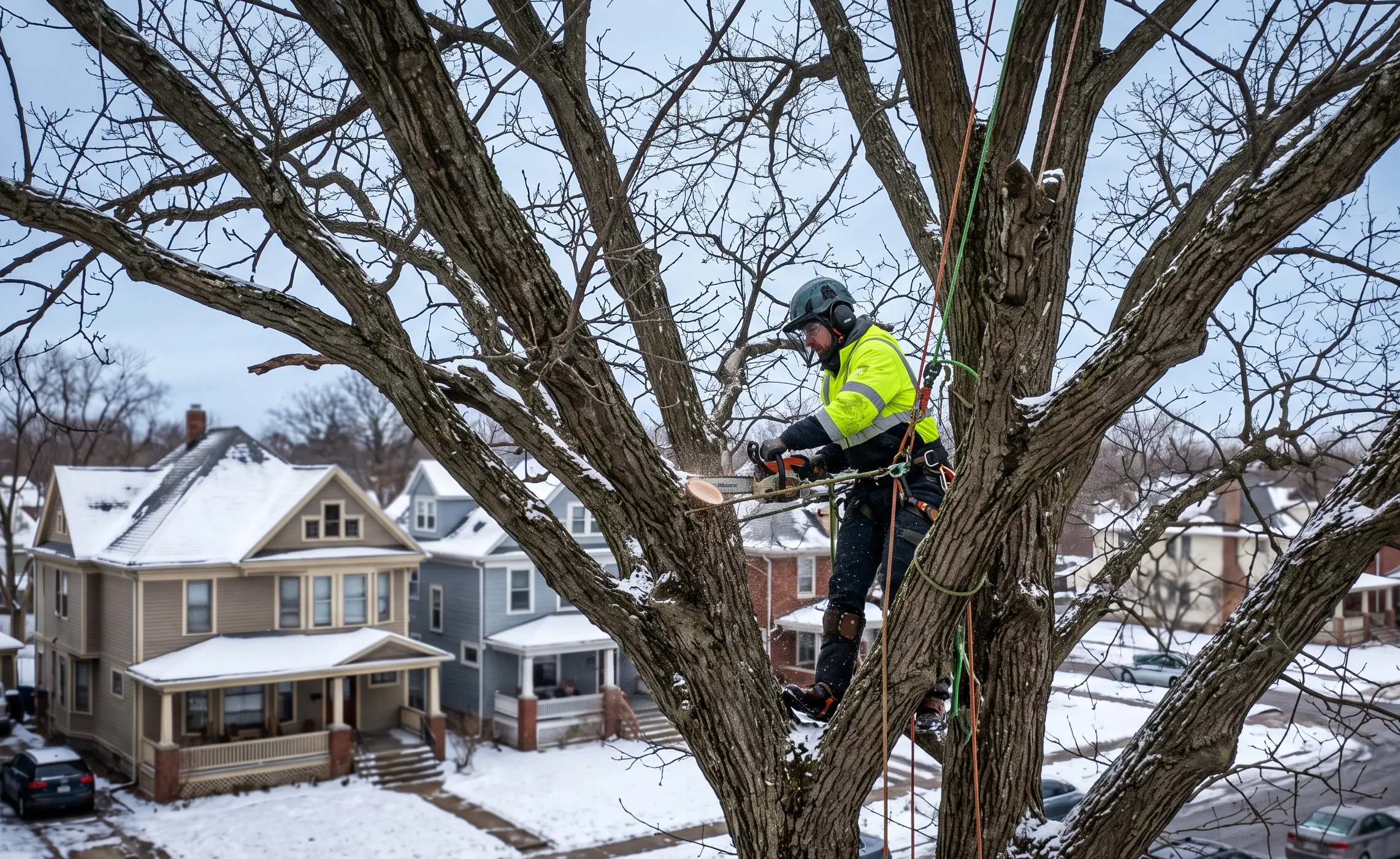
For homeowners throughout Buffalo and Western New York, dormant pruning is one of the most effective ways to safeguard mature canopies against brutal lake-effect weather while setting up explosive spring growth. When deciduous trees drop their leaves in late autumn and enter winter dormancy, their metabolic processes slow to a halt, sap movement recedes, and their bare skeletal structure is laid bare. At Skyline Tree Care (dispatched directly from our yard at 332 Cable St, Buffalo, NY 14206), our certified tree care specialists spend late fall through late winter performing strategic structural tree pruning and trimming across North Buffalo, Elmwood Village, South Buffalo, Allentown, Parkside, Kaisertown, and surrounding Erie County suburbs. Dormant pruning is not mere aesthetic shaping—it is proactive tree risk management that prevents devastating winter storm branch failures, halts the spread of regional vascular pathogens, and protects your home and family before heavy winter snow and gale-force lake winds strike.
1. What Is Dormant Pruning? (The Botanical Science)
Dormant pruning refers to the deliberate, selective removal of live, dead, weakened, or crossing branches while a woody perennial is completely inactive—typically between late November and early March across USDA Plant Hardiness Zones 6a and 6b in Western New York.
The Tree’s Annual Biological Cycle
To understand why dormant pruning is biologically superior to warm-weather cutting, consider how a deciduous tree allocates its vital resources across the four seasons:
- Spring (Bud Break & Foliar Expansion): High internal hydraulic pressure surges upward through sapwood xylem. The tree expends stored energy at peak velocity to unfurl leaves and push new shoots. Pruning now interrupts vital energy deployment.
- Summer (Photosynthesis & Transpiration): Foliage actively manufactures carbohydrates through sunlight while transpiring gallons of water daily. Removing leafy branches in summer strips away active food factories and causes moisture stress.
- Fall (Nutrient Withdrawal & Abscission): Triggered by shortening daylight and chilling temperatures, trees pull mobile starches, nitrogen, and carbohydrates out of the foliage, channeling them deep into the root architecture and interior trunk wood before leaves drop.
- Winter (True Dormancy & The Ideal Pruning Window): Metabolic functions slow to near zero. Sap movement recedes, energy is securely banked underground, and transpiration halts. Cutting during deep dormancy preserves 100% of the root zone’s stored food supply while preparing the tree to compartmentalize wounds the moment temperatures warm.
When pruning cuts are executed just before bud swell in late winter, the tree’s cellular cambium is primed to burst into action come April, rapidly forming protective woundwood (callus tissue) across the cut perimeter via Compartmentalization of Decay in Trees (CODIT).
Frequently Asked Questions
Q: Exactly which months count as the dormant pruning window in Buffalo?
A: In Western New York, true dormancy generally spans from late November (after complete leaf drop) through late March or early April (before buds swell and break open).
Q: Does trimming a branch during dormancy shock the root system?
A: No. Because vital starches and sugars have already moved into the trunk and root zone for winter storage, selective branch removal does not deplete the tree’s energy reserves.
Q: What is CODIT in arboriculture?
A: CODIT stands for Compartmentalization of Decay in Trees. It is the tree’s natural biological defense system that produces chemical and physical boundaries (“walls”) around pruning wounds to wall off fungal decay and prevent rot from traveling into heartwood.
2. Why Buffalo’s Climate Demands Dormant Pruning
Tree care in the Queen City is fundamentally different from caring for trees in milder or inland climates. Between November and April, Buffalo trees face three relentless microclimate pressures:
Heavy Lake-Effect Snow and Wet Surcharge Loads
Lake Erie remains unfrozen well into early winter. Cold Arctic air sweeping over warm lake waters unleashes legendary lake-effect snowbands that dump feet of dense, water-logged snow within hours. A mature silver maple or honey locust holding weak branch unions, co-dominant stems, or excessive internal twigging collects thousands of pounds of added weight. Dormant pruning thins dense interior branchlets and eliminates structural weaknesses, drastically reducing the surface area available to trap heavy snowpack.
Extreme Lake-Effect Wind Tunneling
Sustained 40-to-60 mph gusts traveling off Lake Erie buffet street trees across open corridors in downtown Buffalo, the Waterfront, South Buffalo, and the lower West Side. Dormant structural pruning relieves “sail effect”—the aerodynamic drag that catches howling winds like a ship’s sail and twists limbs until they shear off at the collar or rip into utility lines. For trees with split trunks or co-dominant leaders, pairing dormant pruning with professional tree cabling and bracing provides critical mechanical reinforcement against severe lakefront wind shears.
Severe Freeze-Thaw Stress
Buffalo winters fluctuate between bitter sub-zero freezes and sudden 50-degree lake thaws. Trees pruned in mid-summer during drought or high heat endure massive water loss and vascular shock. Pruning in the deep freeze keeps cuts dry, cold, and biologically inactive, preventing winter sunscald and frost cracks along vulnerable branch bark ridges.
Frequently Asked Questions
Q: Will lake-effect snow weigh down a tree less if it is pruned in winter?
A: Yes. Strategic pruning removes dense, crossing interior twigs and non-essential lateral growth, drastically reducing surface area where heavy snow and freezing rain accumulate.
Q: How does pruning reduce wind risk during Buffalo winter storms?
A: Thinning the canopy reduces the tree’s “sail effect.” High-velocity wind passes cleanly through the open branch structure rather than catching the crown and twisting the trunk.
Q: Can dormant pruning protect my roof from snow-loaded overhangs?
A: Yes. Clearing branches back 8 to 10 feet from rooflines eliminates the danger of snow-laden limbs bowing downward and scraping shingles, crushing gutters, or puncturing slate.
3. Structural Visibility: Seeing the Skeleton Without the Leaves
One of the greatest operational advantages of dormant pruning is unobstructed visual access. During the summer, a dense green canopy hides life-threatening structural flaws from even trained eyes. Once foliage drops, arborists can inspect the branching architecture in full 360-degree clarity.
What Arborists Identify During Bare-Branch Inspections:
- Co-Dominant Stems with Included Bark: Narrow V-shaped unions where bark pinches inward, creating high-risk split points under storm tension.
- Crossing, Chafing, and Self-Girdling Branches: Limbs that rub against one another, stripping protective bark and opening entry wounds for pests.
- Deep Frost Cracks and Trunk Cavities: Structural fissures hidden behind summer leaf clusters.
- Latent Fungal Conks, Bleeding Cankers, and Tip Dieback: Visual indicators of decaying wood fiber or vascular disease.
- Unbalanced Weight Distribution: Asymmetric canopy lean extending over rooflines, sunrooms, electrical drop wires, and driveways.
When two limbs rub together during summer breezes, the bark wears away, creating an open gateway for wood-boring insects and rot-inducing fungi. In winter, an arborist can instantly identify crossing branches, select the offending limb, and execute a clean cut at the branch bark ridge without disturbing the healthy companion branch.
Frequently Asked Questions
Q: Can arborists spot dead branches if there are no leaves to show which ones are green?
A: Absolutely. Certified arborists inspect terminal bud development, bark color, branch flexibility, and cambium health beneath the bark, easily distinguishing deadwood from live wood.
Q: Why are V-shaped branch unions so dangerous compared to U-shaped unions?
A: V-shaped unions often develop “included bark,” meaning bark grows inward between two competing stems rather than connecting as solid wood. Under ice or wind loads, this lack of connective fiber causes catastrophic split failures.
Q: What is canopy thinning versus canopy topping?
A: Thinning selectively removes specific interior branches to improve airflow and light penetration according to ANSI A300 standards. Topping is the indiscriminate, harmful heading of large limbs that creates massive decay pockets and weak shoots; certified arborists never top trees.
4. Pathogen and Pest Defense: The Disease Prevention Window
Western New York’s urban forest contends with a variety of aggressive fungal diseases, bacterial blights, and invasive insects. In warm weather, fresh tree sap releases chemical volatiles (terpenes, ethanol, and aldehydes) that act as homing beacons for pests and fungal spores.
| Tree Species | Dangerous Pathogen / Vector | Why Dormant Pruning Protects the Tree |
| Oak (Red & White) | Oak Wilt (Bretziella fagacearum) | Sap-feeding nitidulid beetles spread deadly spores to fresh cuts from April to October. In freezing weather, beetles are dead or overwintering underground, making winter the only safe window to prune oaks. |
| Apple, Crabapple, Pear | Fire Blight (Erwinia amylovora) | Systemic bacteria travel through warm vascular tissue. Cold-weather pruning stops the spread, allowing clean excision of cankers without bacterial drip into open wounds. |
| Fruit Trees (Plum, Cherry) | Black Knot (Apiosporina morbosa) | Unsightly black fungal galls release spores in wet spring conditions. Winter cuts safely remove galls 4–6 inches below margins while the fungus is completely dormant. |
| Dutch Elm / Native Elms | Dutch Elm Disease (Ophiostoma) | Elm bark beetles breed in warm weather wood cuts. Dormant pruning ensures wounds seal before spring beetle flights begin. |
Frequently Asked Questions
Q: Why should oak trees never be pruned during late spring or summer in Buffalo?
A: Fresh pruning wounds release sap odors that attract nitidulid sap beetles carrying oak wilt fungal spores. To keep oaks safe, all pruning must occur during freezing winter months.
Q: Does dormant pruning eliminate black knot on ornamental cherry and plum trees?
A: Pruning galls 4 to 6 inches below active infections while spores are dormant prevents fungal distribution and removes the infested wood before springtime moisture triggers spore release.
Q: What should be done with diseased branches cut down during winter?
A: Diseased limbs should never be left on the property or used for garden mulch. Professional crews chip and haul infected wood off-site to stop pathogens from reinfecting healthy nearby trees.
5. Protecting Your Landscape and Lawn Equipment
Homeowners often worry about heavy machinery damaging their manicured lawns, brick walkways, and flowerbeds during summer service calls. Dormant pruning completely eliminates this concern:
- Frozen Turf Protection: In mid-winter, buffalo topsoil freezes solid. Bucket trucks, tracked mini-skidders, and chip wagons can traverse yards without rutting sod, crushing topsoil, or shearing perennial bulbs beneath the surface.
- Perennial Garden Safety: Hostas, hydrangeas, daylilies, and ornamental shrubs are dieback perennials that sit safely dormant or under a snow blanket. Rigged limbs lowered to the ground touch snow rather than fragile blooming plants.
- Pristine Debris Management: Dormant branches are brittle, dry, and leaf-free. Wood chippers process bare hardwoods cleanly and quickly, producing nutrient-dense wood chips without leaving sticky leaf mulch across your lawn.
Frequently Asked Questions
Q: Will heavy arborist equipment tear up my yard in January or February?
A: Buffalo yards are typically frozen solid in mid-winter. Ground-pressure equipment and tires roll over frozen ground or snow cover without leaving deep ruts or compacting wet spring mud.
Q: What happens to the pruned wood and branches?
A: Crews feed bare branches directly into commercial chippers on-site, chipping the material cleanly and hauling away debris or leaving rich, clean wood mulch if requested.
Q: Can dormant pruning be performed if there is a foot of snow on the ground?
A: Yes. Professional tree care crews work in snow conditions daily across Western New York, using snow-shoeing or clearing access paths to establish secure rigging and drop zones.
6. How Skyline Tree Care Executes Dormant Pruning: The ANSI A300 Standard
At Skyline Tree Care, our crews never practice destructive topping, flush cuts, or lion-tailing. We adhere strictly to ANSI A300 industry standards for tree pruning, ensuring every single cut respects the biological anatomy of the tree:
The ANSI Three-Cut Method
When removing substantial limbs, making a single top-down cut causes the heavy branch to snap under its own weight, peeling bark down the trunk—a severe injury known as “bark tearing.” Our crews always follow the disciplined three-cut protocol:
- Cut 1 (The Undercut): Made roughly 12 to 18 inches away from the trunk on the bottom of the limb, cutting upward about one-third of the way through. This severs the bark’s tension line.
- Cut 2 (The Relief Cut): Made from the top down, an inch or two further out than the undercut. The branch breaks cleanly away at the relief point without stripping the trunk bark.
- Cut 3 (The Branch Collar Finish): Made with surgical precision just outside the branch bark ridge and swollen collar zone. This protects the branch protection zone so internal chemical defenses seal the cut naturally.
Frequently Asked Questions
Q: What is a flush cut, and why is it dangerous?
A: A flush cut removes the swollen branch collar flush against the trunk. This cuts into trunk tissue, disables the tree’s natural healing boundary, and creates open corridors for internal heartwood decay.
Q: Do cuts need to be painted with tar or tree wound sealants?
A: No. Modern arboriculture confirms that wound dressings trap moisture, encourage wood rot, and delay natural callus formation. Clean cuts made at the branch collar seal themselves naturally.
Q: What is lion-tailing, and why should it be avoided?
A: Lion-tailing is the improper practice of stripping out all interior foliage and branches, leaving leaves only at the tips of limbs. This shifts weight to the ends of branches, dramatically increasing the risk of breakage under wind and snow.
7. Buffalo Neighborhood Tree Care Profile
Every pocket of Buffalo possesses its own distinct architectural and botanical footprint. Our neighborhood-specific approach ensures historical and urban canopy preservation across Erie County:
- Elmwood Village & Allentown: Characterized by narrow zero-lot-line yards, historic Queen Anne and Victorian homes, and towering 80-year-old Silver Maples, Norway Maples, and Lindens. Dormant pruning here focuses on deadwood removal over delicate slate roofs, high-voltage drop clearance, and tight-quarter rope rigging.
- North Buffalo & Parkside: Flanked by historic Olmsted-designed parkways and park systems with sprawling pin oaks, sycamores, and sugar maples. Dormant pruning focuses on canopy elevation, structural wind-thinning, and clearance from overhead street utility lines.
- South Buffalo & Kaisertown: Dense residential parcels where legacy trees frequently hang over property lines, shared garages, and narrow driveways. Winter pruning prevents snow-laden limb drops that threaten parked vehicles, fences, and neighbor relations.
Frequently Asked Questions
Q: Can you prune large street trees in narrow Elmwood Village or Allentown side yards?
A: Yes. Crews utilize specialized rope rigging, compact aerial work platforms, and friction lowering devices to dismantle and trim limbs within tight lot lines without touching adjacent roofs or fences.
Q: Does Skyline Tree Care handle utility clearance work?
A: We safely trim limbs, clearing primary house drop lines and service wires on private residential property, adhering to strict electrical hazard awareness protocols.
Q: What happens if a tree in South Buffalo or Kaisertown has roots damaging a foundation or driveway?
A: Our arborists inspect the root flare and canopy balance. If structural roots have failed or lifting is irreversible, we evaluate whether pruning can stabilize the tree or if complete tree removal is the safest long-term option.
8. Finding Certified Dormant Pruning “Near Me” in Buffalo & Erie County
When Western New York property owners search for reliable dormant pruning or tree trimming “near me,” proximity and rapid dispatch matter—especially when winter storms threaten heavy branch failures. Because winter weather in Erie County changes in minutes, hiring a tree care service stationed within the metropolitan core ensures faster crew response times and arborists intimately familiar with local soil conditions and municipal tree codes.
From our dispatch yard at 332 Cable St, Skyline Tree Care provides direct, rapid-dispatch tree trimming, structural pruning, and emergency branch removal throughout:
- Central & North Buffalo: Elmwood Village, Allentown, Delaware District, Parkside, North Park, Hertel Avenue corridor, and Black Rock.
- South Buffalo & Waterfront: Kaisertown, Seneca, Abbott Road corridor, Old First Ward, and South Park.
- Immediate Erie County Suburbs: Cheektowaga, West Seneca, Lackawanna, Amherst, Tonawanda, and Kenmore.
Whether your home borders an Olmsted parkway with century-old Pin Oaks or sits on a compact city lot with tight property lines, finding local tree service near you means working with arborists who understand local lake-effect snow loads and frozen-turf rigging protocols. If severe weather leads to an emergency split trunk or tree on your roof, our local crews are dispatched 24/7 for emergency storm tree work.
Frequently Asked Questions
Q: How quickly can a local Buffalo tree crew inspect my property after a winter storm?
A: Because our yard is centrally located at 332 Cable St, our estimators provide same-day or 24-hour on-site assessments across Buffalo and immediate Erie County suburbs.
Q: Do I need a city permit for dormant pruning on my Buffalo property?
A: Pruning private trees on your residential property does not require a city permit. However, if limbs extend into the municipal street right-of-way or touch utility lines, certified arborists coordinate work according to city codes.
Q: Do you offer free on-site estimates for dormant tree trimming near me?
A: Yes. Skyline Tree Care offers 100% free, upfront, in-person written estimates for all residential and commercial properties in Buffalo, Cheektowaga, West Seneca, Amherst, and across Erie County.
9. Common Signs Your Buffalo Trees Need Dormant Pruning This Season
Inspect your yard this week. If you notice any of the following visual cues, your tree requires dormant pruning before spring arrives:
- Dead, Snapped, or “Hanger” Branches: Deadwood that died during summer droughts now sits suspended in the upper canopy, waiting for a 40 mph gale to bring it crashing down.
- V-Shaped Crotches (Included Bark): Main stems that fork at acute angles instead of a broad U-shape; these act as mechanical wedges that split in heavy ice.
- Low Canopy Interference: Limbs drooping within 8 feet of sidewalks, 14 feet of streets, or rubbing directly against your gutters, roof shingles, and siding.
- Water Sprouts and Root Suckers: Weak, vertical shoots that pull vital moisture and nutrients away from the central dominant leader.
- Dense, Cluttered Canopies: Canopies so packed with internal crossing branches that birds struggle to fly through and sunlight cannot reach your underlying turf.
Frequently Asked Questions
Q: How can I tell if a branch hanging over my roof is structurally compromised?
A: Look for peeling bark, lack of viable winter buds, fungal growth at the branch union, or deep transverse cracks near the attachment point.
Q: Will removing low branches harm the tree’s health?
A: No. Elevating the lower canopy (crown raising) removes low-vigor branches, clears walkways, improves driveway sightlines, and allows sunlight to reach your lawn while maintaining the tree’s health.
Q: What should I do if a branch has already cracked and is hanging over power lines?
A: Never attempt to touch or cut branches near wires yourself. Call utility providers and contact certified emergency tree experts immediately.
Frequently Asked Questions
Q: Isn’t it too cold to prune trees in the middle of a Buffalo winter?
A: Not at all. Deciduous trees do not feel temperature the way mammals do; cold weather actually preserves wood tissue and prevents rapid microbial rot. As long as temperatures are not so frigid that wood becomes glass-brittle (typically below zero degrees Fahrenheit), winter is the ideal biological window for major structural pruning.
Q: Can birch or maple trees be pruned in late winter if they “bleed” sap?
A: Yes. Maples, birches, and walnuts may weep sap if pruned in late February or March as root pressure begins to build. While this sap leakage can look alarming to a homeowner, it is almost entirely water and dissolved minerals; it does not harm the tree or drain its energy reserves. Over time, the tree closes the wound naturally without the need for wound dressings or paint.
Q: Can all tree species be pruned during the winter?
A: Most deciduous shade and ornamental trees thrive with dormant pruning. However, spring-flowering trees like lilacs, magnolias, and forsythias set their flower buds the previous autumn. Pruning them in winter will remove spring blooms. While winter pruning won’t harm their overall health, we usually recommend pruning spring bloomers immediately after they finish flowering if flower display is your top priority.
Q: How often should mature trees in Buffalo receive dormant pruning?
A: Most mature shade trees (such as oaks, maples, and ashes) benefit from professional structural pruning every 3 to 5 years. Younger establishing trees benefit from developmental pruning every 2 to 3 years to ensure a strong single central leader and balanced scaffold branching.
Q: If a tree has to come down completely, is winter also a good time for tree removal?
A: Yes. Winter is one of the best times for complete tree work. The frozen ground protects lawns from heavy equipment, surrounding perennials are dormant, and branches are lighter without summer leaves, allowing for safe, sectional rigging. If a tree is dead, hazardous, or structurally unviable, pairing winter pruning with stump grinding and removal leaves your property clean and ready for spring lawn seeding.
Schedule Your Winter Tree Inspection with Skyline Tree Care
Don’t wait for a heavy February lake-effect blizzard to test whether your trees can handle Western New York winter weather. Proactive dormant pruning protects your family, safeguards your property value, and sets your canopy up for decades of vibrant health.
The certified team at Skyline Tree Care provides free, upfront, in-person written estimates for all residential and commercial tree services throughout Buffalo and Erie County. We inspect the entire tree structure, detail required clearances, explain our ANSI A300 trimming strategy, and provide complete cleanup and haul-away with zero hidden fees.
Our Buffalo Yard & Service Area
Below is our direct Google Business Profile map location. You can view our central location in Kaisertown, calculate the travel distance to your property, or get directions directly to our facility: