
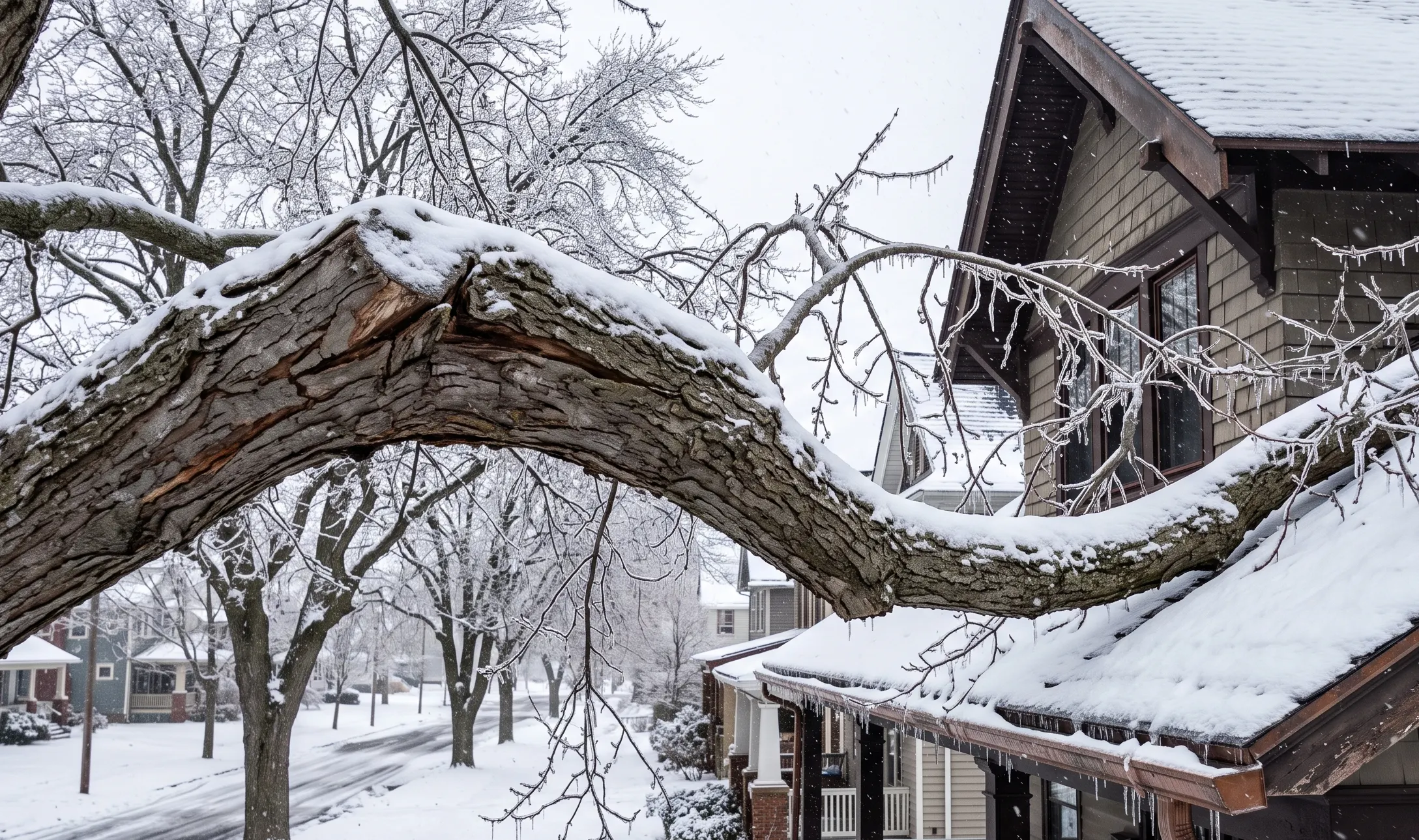
Western New York winters are notorious for their sudden, ferocious lake-effect squalls and crushing freezing rain events. When moisture lifts off warm Lake Erie and collides with freezing Arctic air masses sweeping across Erie County, the result is dense, water-logged snow and glaze ice capable of turning majestic shade trees into severe structural hazards. For Buffalo homeowners, hearing a gunshot-like crack in the backyard at 2:00 AM is a harrowing experience. Understanding how heavy lake-effect snow and ice break mature branches—and knowing what preventative arborist interventions work before winter sets in—is essential to safeguarding your property, your family, and the architectural canopy of our historic neighborhoods.
1. The Physics of Branch Failure: Why Lake Snow and Glaze Ice Are Uniquely Destructive
Every mature branch functions structurally as a cantilever beam anchored at the tree’s trunk or a primary parent stem. Under normal conditions, healthy hardwood bends under its own weight and flexes naturally in the wind. However, lake-effect snow and freezing rain alter this structural equation through catastrophic dead-weight loading and aerodynamic friction.
Moisture Content: Lake-Effect “Cement” vs. Fluffy Powder
Winter precipitation is not created equal across the meteorological spectrum:
- Champagne Powder (Dry Snow): In bitter-cold, dry air, snow might have a snow-to-water ratio of 20:1 or 30:1. It blows straight through bare deciduous canopies and sheds easily from conifer needles, weighing roughly 3 to 5 pounds per cubic foot.
- Lake-Effect Snow (Early-to-Mid Season): Lake Erie retains residual autumn heat well into December and January. When sub-freezing winds blow across miles of unfrozen open water, they pick up copious moisture and dump supercooled, high-density snow over Buffalo, Amherst, Cheektowaga, Orchard Park, and West Seneca. This snow often has a ratio of 6:1 or 8:1, weighing anywhere from 12 to 20 pounds per cubic foot.
- Glaze Ice (Freezing Rain): When rain passes through a shallow sub-freezing air layer near the ground, it supercools and instantly freezes upon impact with cold wood, coating branches in solid, crystal-clear glaze ice weighing approximately 57 pounds per cubic foot.
The Leverage Multiplier (Bending Moments)
As heavy, sticky snow builds up on the tips of an outstretched horizontal branch, basic structural mechanics dictate failure thresholds:
A 200-pound load of wet lake-effect snow sitting 20 feet away from the trunk creates a 4,000 foot-pound torque at the branch union. As that branch sags under the initial load, its surface area flattens out, catching even more falling snow. When wind gusts from Lake Erie hit 40 to 60 mph during winter storms, the dynamic kinetic force easily exceeds the modulus of rupture—the tensile and shear strength of the wood fibers—causing immediate, catastrophic failure.
Frequently Asked Questions
Why does lake-effect snow stick to bare branches more than standard snow?
Lake-effect precipitation is generated by warm, moisture-rich air lifting off open lake water. Because ambient ground temperatures during these events often hover near the freezing threshold (between 28°F and 34°F), the snowflakes contain high moisture levels, forming a slushy adhesive bond on bark ridges and twigs that locks in place before freezing solid.
At what thickness does glaze ice become dangerous to mature limbs?
Structural engineers and certified arborists recognize that a radial coating of one-quarter inch of ice adds substantial load, while one-half inch to three-quarters of an inch of glaze ice increases the deadweight of a limb by twenty to thirty times its dry weight. At one inch of radial accumulation, even healthy mature branches begin snapping spontaneously without wind.
2. Anatomical Weaknesses That Turn Stately Trees Into Winter Hazards
Not every limb snaps under heavy winter accumulation. In most instances, structural failure during a Buffalo winter exposes a structural precondition that was quietly worsening for years beneath the bark.
Structural Comparison: V-Shaped vs. U-Shaped Unions
In a healthy U-shaped branch union, the connection forms a broad, curved angle where the branch meets the trunk. This configuration develops a thick, interlocking branch collar composed of continuous wood fibers that distribute seasonal stress evenly around the joint.
In contrast, a narrow, V-shaped union features two co-dominant stems growing tightly together at an acute angle. Because there is insufficient space for the wood fibers to interlock, the bark between the stems gets squeezed and trapped. This inward-turning layer of trapped bark, known as included bark, prevents the two stems from fusing into solid wood. It forms a permanent, hidden seam of weakness that acts as an entry point for decay fungi and operates like a wedge when snow weight pulls the stems in opposite directions.
Key Anatomical Risk Factors
- Included Bark and V-Shaped Branch Unions: When two codominant stems grow tightly together in an acute, narrow “V” angle, the bark cannot knit into solid wood. This creates an unbonded, sliding seam. Wet snow pushes the twin stems apart like an iron wedge, splitting the trunk down the center.
- Excessive End-Weight and Over-Extended Horizontal Limbs: Branches that grow excessively long with all their lateral twigs and foliage mass concentrated at the outer tips (often called lion’s-tailed limbs, frequently caused by improper, aggressive interior pruning) act like fishing rods with heavy lead sinkers. When snow piles onto the tips, the branch bends dramatically, overstretching the top fibers in tension failure and crushing the lower fibers in compression failure.
- Internal Decay and Heartwood Rot: Fungal pathogens—such as Armillaria, Ganoderma, or Phellinus—silently digest the structural cellulose and lignin from the inside out. A branch or trunk can appear leafy and full in August, yet harbor a hollow or spongy center. When winter strips away thermal dampening and adds hundreds of pounds of freezing snow, these compromised wood shells buckle.
- Girdling Roots and Winter Soil Anchoring: Lake-effect storms are frequently preceded by unseasonably mild temperatures or damp rain that saturates the soil before temperatures plummet. Heavy snow loading on the canopy places extreme leverage on the root plate. Trees with circular girdling roots or shallow root systems in compact urban soils can undergo complete root plate lift, tipping the entire tree over into fences, garages, or power lines.
Frequently Asked Questions
Can a tree look completely healthy in summer and still snap in winter?
Yes. Sapwood and outer cambium layers transport water and nutrients to keep leaves vibrant green even when the inner heartwood—the structural core—is hollowed out by wood-decay fungi. Visual canopy fullness in July is not an accurate indicator of interior wood integrity under winter snow stress.
What causes lion’s-tailing, and why does it make winter breakage worse?
Lion-tailing is caused by uncredentialed tree cutters stripping out all the inner branches and foliage along a limb, leaving only a puff of growth at the outer end. This shifts the limb’s center of gravity far out to the perimeter, eliminates dampening branches that absorb wind vibration, and dramatically increases torque during heavy snow accumulation.
3. High-Risk vs. Resilient Tree Species in Western New York Landscapes
Buffalo’s rich urban forest is filled with both native and introduced canopy species. Certain trees handle lake-effect conditions with ease, while others are notorious brittle liabilities that require frequent attention.
Vulnerable Species (High Risk of Winter Limb Failure)
- Silver Maple (Acer saccharinum): Extremely rapid growth produces brittle, porous wood with frequent narrow crotches and deep internal pockets of decay. These are the primary sources of midnight emergency storm calls across Buffalo.
- Bradford / Callery Pear (Pyrus calleryana): Characterized by dense, upright branching clusters originating from a single point on the trunk. Snow and ice routinely split these ornamental trees completely in half.
- Green & White Ash (Fraxinus spp.): Severely compromised by the Emerald Ash Borer across Erie County, dead and unmanaged ash limbs become dry, brittle, and fracture unpredictably under minor winter loads.
- Siberian Elm & Boxelder: Weak branch junctions and soft wood make them prone to snapping under moderate ice build-ups.
- Willow (Salix spp.): Weak-wooded, wet-ground lovers that retain heavy surface loads and snap cleanly under cantilever stress.
Resilient Species (Engineered for Heavy Snow Loading)
- White Oak & Bur Oak (Quercus alba, Q. macrocarpa): Exceptionally dense wood fiber, wide branch union angles, and massive structural collars built to withstand high torque.
- Sugar Maple (Acer saccharum): Considerably stronger wood fiber than Silver Maple, holding up well under structural formative pruning.
- Ginkgo (Ginkgo biloba): Flexible branch architecture and exceptional cellular wood strength allow it to shed loads without catastrophic tearing.
- Eastern Hemlock & Native Conifers: Conical architectures with flexible, downward-sloping branches that gently droop under snow to shed the load, then spring back upright when the weather warms.
Frequently Asked Questions
Why are Bradford Pears still so common if they break so easily in the winter?
Bradford pears were planted heavily by suburban developers throughout the 1980s and 1990s due to their fast growth, symmetrical spring blossoms, and tolerance of poor soils. Their flawed branching architecture only reveals itself after fifteen to twenty years, when the limbs become heavy enough to split under lake-effect loads.
Can weak-wooded trees like silver maples be saved from storm damage?
Yes. While you cannot alter the species’ genetic wood density, proactive structural pruning to eliminate co-dominant leaders, reduce outer end-weight, and install dynamic support cables can preserve a mature silver maple safely for decades.
4. How to Prevent Winter Storm Damage (Certified Arborist Strategies)
Mitigating winter storm failure is not about indiscriminate cutting. In fact, improper tree hacking makes trees dramatically more dangerous in subsequent winters. Buffalo homeowners can protect their landscape assets through four proven methods.
1. ANSI A300 Structural Reduction Pruning
Rather than topping a tree (which creates weak, poorly attached water-sprouts prone to immediate failure), a certified arborist uses structural end-weight reduction. By carefully trimming 10% to 20% of the live branch tips back to strong lateral branches, we significantly reduce the cantilever leverage. This preserves the tree’s health while ensuring that snow loads accumulate closer to the sturdy trunk, dramatically lowering failure risk.
2. Crown Thinning & Canopy Balancing
Thinning removes crossing, rub-damaged, and suppressed branches, allowing wind, wet snow, and ice to pass through the canopy with minimal aerodynamic drag. It also targets long, off-balance codominant leaders that overhang rooflines, driveways, and utility service lines.
3. Dynamic Cabling & Steel Bracing Systems
For mature, heritage trees with co-dominant stems or split “V” unions that you want to preserve (such as an ancient sugar maple shading your patio), tree cabling and bracing provide artificial structural support.
- Synthetic Dynamic Cables: Installed in the upper two-thirds of the canopy, connecting two or more large stems. The cables remain slack during mild weather to allow the tree to sway naturally and build wind-firm reaction wood but pull tight during heavy ice and snow loading to prevent the crotch from splitting open.
- Through-Rod Bracing: For branches or trunks that have already begun to fissure, heavy-duty threaded steel rods can be bored through the union to physically bolt the split together, backed up by overhead cables.
4. Pre-Winter Hazard Audits
A certified arborist inspects trees when the leaves drop in autumn. Bare canopies make it easy to spot hidden deadwood, fungal conks, carpenter ant colonies, hollow cavities, and cracked unions that are completely invisible in midsummer.
Frequently Asked Questions
Will pruning branches right before winter harm the tree?
No. Late autumn and early winter—once deciduous trees have entered total dormancy—is actually one of the safest times to prune. Dormant pruning minimizes sap loss, eliminates the risk of transmitting insect pests and fungal spores, and causes no shock to the tree’s energy reserves since photosynthesis has ceased for the season.
How long does an arborist support cable last once installed?
High-strength synthetic dynamic cabling systems typically have an operating lifespan of seven to ten years before requiring replacement, while traditional steel EHS (Extra High Strength) cable systems can last fifteen to twenty years. All support systems should be inspected annually by a certified arborist to verify tension and collar clearance as the tree grows.
5. What Homeowners Must NOT Do During a Storm
When an ice storm or lake-effect squall hits Western New York, homeowners naturally want to help their struggling trees. However, well-intentioned reactions often cause more damage than the storm itself.
- DO NOT Beat Branches with Brooms, Rakes, or 2x4s: Frozen wood fibers are brittle. Striking a heavily bent, ice-coated limb induces rapid shock waves that cause the branch to snap off completely or tear the vascular cambium beneath the bark.
- DO NOT Stand Under Bent, Loaded Canopies: Loaded branches are held under tremendous kinetic tension, functioning as spring poles. When the load shifts or the wood fractures, the branch can lash downward or whip violently, causing fatal head trauma.
- DO NOT Attempt Tree Work Near Power Lines: Snow-laden branches frequently make contact with service drops and utility high-voltage lines. Ice and wet wood conduct electricity effortlessly. Always call National Grid or NYSEG and professional crews to address limbs within striking distance of wires.
- DO NOT Top Your Trees to “Make Them Safe”: “Tree topping” or rounding-over destroys the tree’s natural defense systems and triggers an explosion of weakly attached sucker growth that breaks off in the very next winter storm. Always insist on certified arborist practices aligned with ANSI A300 standards.
Frequently Asked Questions
Is it safe to spray warm water from a garden hose to melt ice off tree limbs?
No. Spraying warm water will quickly freeze in sub-freezing air, adding substantial extra water weight to already overburdened branches before it drains away. The thermal shock can also damage cold-hardened bark tissue.
What should I do if a snow-laden branch is touching my roof?
Do not climb onto the roof or try to push the limb away during the storm. Keep everyone out of the room below the contact point, inspect the ceiling from the inside for leaks or structural stress, and wait for the weight to thaw or call an emergency arborist equipped with bucket access to safely relieve the load.
6. Real-World Case Study: Preserving a Historic Parkside Elmwood Silver Maple
In the fall of 2024, our team at Skyline Tree Care was called to a residential property in Buffalo’s Parkside neighborhood, just blocks from Delaware Park.
The Problem
The homeowner had a massive, 65-foot silver maple with three co-dominant stems overhanging both their Victorian roofline and their neighbor’s glass greenhouse sunroom. A narrow crotch near the center had started weeping moisture, indicating included bark and active structural stress. With heavy lake-effect snow forecasts approaching, the homeowner feared they would have to completely felled the 80-year-old centerpiece tree.
The Arborist Intervention
Our crew performed an aerial lift assessment, identifying hollow spots and confirming that the primary cambium layer was healthy enough to anchor supplemental support. We pruned out dead interior wood and selectively reduced 18% of the foliage weight from the extended lateral tips that hung over the two structures. Finally, we installed a triangular dynamic cable system between the three co-dominant stems at approximately two-thirds of the canopy height. This allowed the limbs to flex naturally during mild wind while preventing catastrophic separation under heavy ice loads.
The Outcome
When a heavy, wet 30-inch lake-effect event pounded the Buffalo metro area that winter, neighboring untrimmed silver maples and boxelders suffered split leaders and property damage. The Parkside maple flexed securely, held its form without shedding a single primary branch, and remains a thriving, shade-giving asset for the neighborhood.
Frequently Asked Questions
How do arborists decide between removing a tree or installing cabling?
The decision is based on an arborist risk assessment assessing three factors: the tree’s structural health (sound wood percentage), the likelihood of failure, and the presence of targets (such as houses, cars, or sidewalks). If sound wood exceeds minimum safety thresholds and the root plate is solid, cabling is preferred to preserve mature property value.
Does installing hardware into a tree trunk harm its health?
When installed by a certified arborist using specialized drop-forged eyebolts or through-rods, the damage is localized and minimal. Healthy trees compartmentalize the small drill hole by forming protective chemical barriers around the hardware, allowing the wood to grow over the exterior fasteners securely without introducing generalized decay.
7. What to Do When a Branch Snaps: Emergency Response & Recovery
If winter conditions overload a branch and cause an active failure, prompt and methodical action minimizes danger. The standard emergency protocol follows four clear stages:
First, isolate the area immediately. Establish a perimeter beneath the canopy at least one and a half times the height of the damaged branch. Hanging, partially broken branches (known as “hangers” or “widowmakers”) can dislodge hours or days after the storm has passed.
Second, check thoroughly for downed utilities. If the limb has brought down power lines or is actively resting on your electrical service mast, stay at least 35 feet away and immediately contact emergency services and your local power utility.
Third, stabilize the broken stub and avoid personal chainsaw work. Operating a chainsaw on fallen wood under mechanical tension and torque is one of the leading causes of winter injury. Limbs can roll, kick back, or snap violently when cut incorrectly. High-risk branches over structures require skilled sectional rigging using friction brakes, lowering ropes, and bucket access.
Fourth, schedule clean finishing cuts. If a limb tears away from the trunk, leaving a jagged strip of bark, a certified arborist must make a clean collar cut to allow the tree’s natural chemical boundary (CODIT—Compartmentalization of Decay in Trees) to seal off the wound and keep wood-boring fungi out.
Frequently Asked Questions
Can a tree heal after a large branch rips off the main trunk?
Trees do not heal damaged tissue the way animals do; instead, they seal it off through compartmentalization. If the branch collar remains intact and the tear does not strip excessive trunk wood, the tree forms calloused wound wood across the margin to prevent decay from penetrating the core.
Will my homeowners insurance cover the cost of removing a fallen branch?
Insurance typically covers removal costs only if the fallen branch damages an insured structure—such as a roof, garage, or fence. If a branch snaps and lands harmlessly on your lawn without structural damage, the cleanup and disposal costs are usually the responsibility of the homeowner.
8. Tree Trimming, Pruning & Winter Storm Preparation “Near Me” in Western New York
When wet lake-effect snow stacks up on your roof and branches start groaning under the weight, you do not have time to wait for out-of-town contractors or dispatchers based in another state. Buffalo homeowners searching for a certified arborist near me or reliable emergency tree service near me need local crews who understand Western New York’s microclimates, mature housing stock, and street-tree municipal codes.
From tight zero-lot-line properties in historic city neighborhoods to expansive suburban acreage, Skyline Tree Care operates directly out of our South Buffalo yard at 332 Cable Street. Our crews provide rapid pre-winter assessments, precision crown thinning, structural cabling, and 24/7 post-storm response across Erie and Niagara counties.
Neighborhoods & Communities We Serve Daily
- City of Buffalo: Elmwood Village, North Buffalo (Hertel corridor), South Buffalo (Seneca/Abbott), Allentown, Parkside, Kaisertown, Black Rock, Lovejoy, and Delaware District.
- Northern Suburbs & Tonawanda Corridor: Amherst, Snyder, Eggertsville, Williamsville, Kenmore, Town of Tonawanda, and Grand Island.
- Southtowns & Lake Shore (Highest Snowfall Belts): Orchard Park, West Seneca, Hamburg, Lackawanna, East Aurora, Cheektowaga, and Lancaster.
Whether you live along the snow-heavy Route 219 and I-90 corridors or near the high-wind zones off Lake Erie’s shoreline, our localized equipment—including tight-access spider lifts, heavy-duty chip trucks, and precision rigging systems—ensures your trees are secured before winter squalls make landfall.
Frequently Asked Questions
How quickly can an arborist near me respond during an active winter lake-effect storm?
During declared severe weather events, Skyline Tree Care prioritizes calls based on immediate hazard levels. Limbs on roofs, compromised electrical lines, and blocked driveways or roadways receive 24/7 priority emergency dispatch. Non-hazardous maintenance or fallen debris on open lawns is scheduled as soon as road travel bans are lifted.
Do you charge for pre-winter on-site tree inspections near Buffalo?
No. Skyline Tree Care provides transparent, written estimates for residential and commercial properties throughout Buffalo and surrounding Erie County suburbs. A qualified team member inspects the canopy, checks for included bark or heart rot, and outlines proactive pruning options with upfront pricing.
Find Our Buffalo Location
To get directions to our operational yard or verify our dispatch proximity to your property, explore our location on the map below:
Protect Your WNY Canopy Before the Next Squall
Mature trees are invaluable landscape assets that clean our air, lower cooling costs in summer, and define Western New York’s historic architectural appeal. But when lake-effect squalls roll off Lake Erie, unmanaged weight and hidden branch defects can turn an asset into a severe emergency.
Whether you live in Elmwood Village, North Buffalo, South Buffalo, Allentown, Parkside, Kaisertown, or anywhere throughout Erie County, proactive structural care is your best insurance policy against winter storms.