
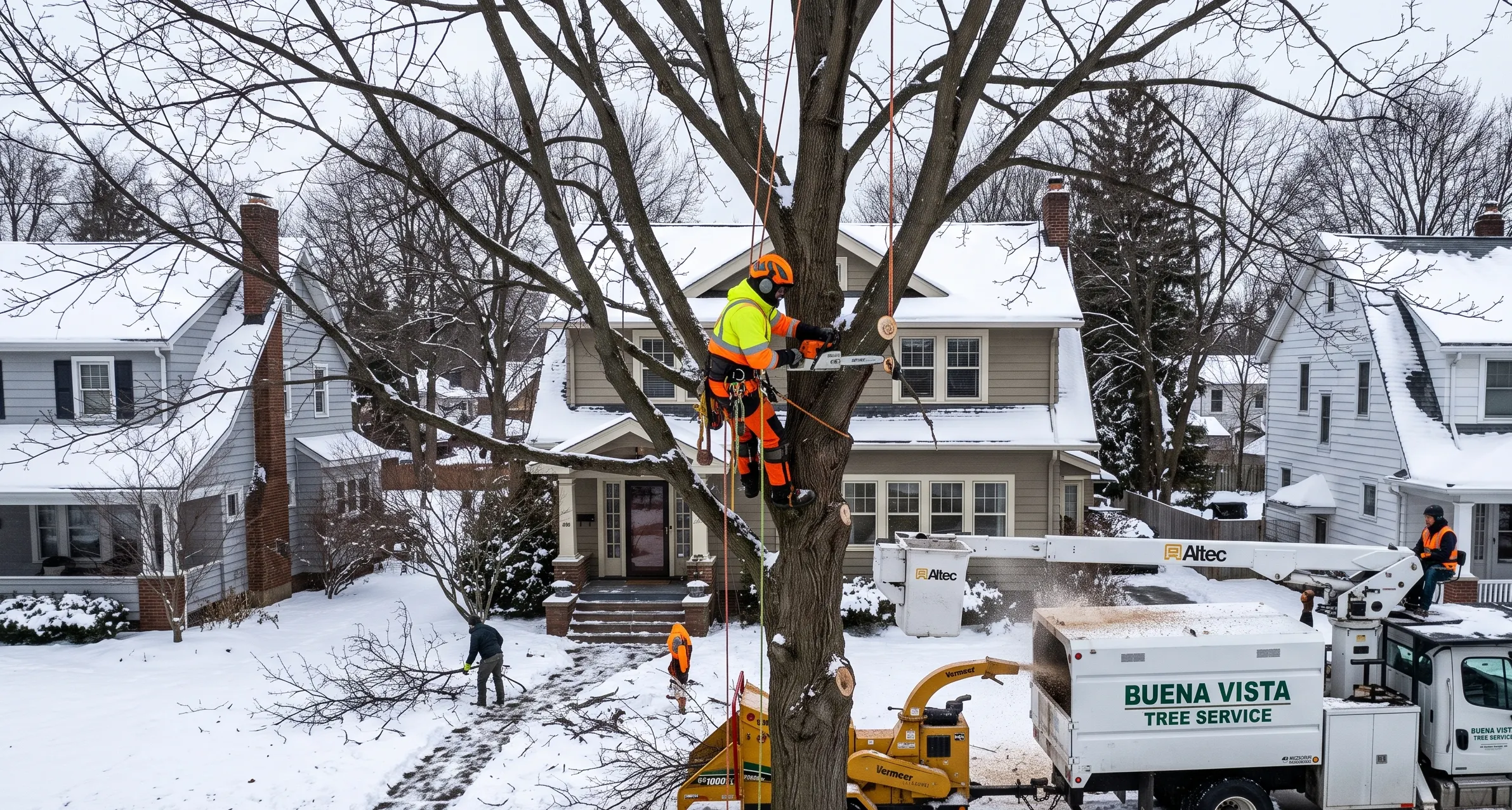
When Western New York settles into December, most homeowners across the Queen City pack away lawnmowers, seal drafty storm windows, and push outdoor property maintenance out of sight until spring thaw. But if you have an aging oak, a leaning silver maple, or a dying green ash looming over your roof, waiting for warm weather is often the most dangerous and expensive mistake you can make. It might sound counterintuitive to book heavy arboricultural work when snow blankets Erie County, but ISA-certified arborists and structural tree specialists know that winter is actually the best time for tree removal in Buffalo.
Between rock-hard frozen turf that shields your residential lawn from heavy tracks and fully dormant canopies that allow for cleaner, faster, lower-friction cuts, cold-weather arboriculture delivers unmatched structural, biological, economic, and safety advantages compared to July or August.
The Buffalo Winter Reality: Why Our Urban Canopy Struggles
To understand why winter tree removal makes sense, you first have to understand what buffalo trees endure. Western New York sits in a unique climatic convergence zone. Lake Erie remains relatively warm through early winter, pumping vast moisture plumes over colder continental air masses. The result is sudden, heavy lake-effect snow bands that dump dense, wet snow—often called “heart attack snow”—followed by ferocious arctic wind gusts screaming across Lake Erie.
Trees across neighborhoods like Elmwood Village, North Buffalo, South Buffalo, and out into Williamsville carry enormous structural loads. A healthy, fully dormant hardwood can handle substantial wind shear, but an unmaintained, dying, or structurally defective tree is an immediate structural risk.
Anatomy of Winter Tree Stress in Western New York
- Lake-Effect Snow Accumulation: Dense, water-saturated snow adheres to broad limbs, multiplying mechanical branch deflection beyond normal load tolerances.
- Sustained Lake Erie Wind Shear: Wind gusts frequently surpassing 50 mph apply intense lateral sway forces across structural trunk unions.
- Internal Fiber Failure: Hidden pockets of fungal decay, included bark crotches, and co-dominant stem splits reach their yield point and fracture under dynamic pressure.
- Property Damage Inevitability: Compromised limbs crash downward onto rooflines, driveways, electrical drops, and structural foundations.
When heavy, wet snow accumulates on weak limbs, or when freezing rain creates a glaze of ice exceeding a quarter-inch, the physical weight exerted on horizontal branch unions increases exponentially. If the heartwood is compromised by internal rot, the wood fibers snap. Removing these hazards are proactively prevented during early winter by preventing sudden middle-of-the-night collapses onto roofs, detached garages, power lines, and parked vehicles.
Frequently Asked Questions
Q: At what point does snow or ice accumulation become critical for tree limbs?
A: A quarter-inch of ice adds noticeable weight, but once ice accumulation reaches a half-inch to three-quarters of an inch, branch weight increases by up to thirty times. When coupled with wind gusts over 40 mph, limbs with interior decay or weak unions frequently snap.
Q: Which tree species in Buffalo are most vulnerable to winter storm damage?
A: Silver maples, boxelders, Bradford pears, and fast-growing willows are notorious for brittle wood and weak, V-shaped crotches. Mature green and white ashes damaged by the emerald ash borer are also prone to sudden failure during winter storms.
1. Frozen Ground Protects Your Landscape from Heavy Equipment
One of the greatest fears Buffalo homeowners express when scheduling tree service is the condition of their yard. In late spring and summer, heavy rainfall saturates Western New York’s dense clay soils. If a crew brings a 10,000-pound mini-skid steer, an aerial lift, or heavy loaders across a damp lawn in Cheektowaga or West Seneca, the equipment ruts the soil, compresses the root zones of adjacent ornamental plants, and leaves behind ruts that require thousands of dollars in topsoil grading and reseeding.
Winter changes the physics of landscape preservation completely.
The Physics of Frozen Soil
When sustained sub-freezing temperatures arrive in December and January, the moisture in Buffalo’s topsoil freezes solid. This creates a concrete-like barrier known as a frozen crust.
- Load Distribution: Tracked loaders and heavy-duty wheeled machinery displace weight across the frozen sub-base without punching through the sod layer.
- Tire Ruts Eliminated: Instead of carving deep trenches into soft mud, equipment glides cleanly over frozen ground and snowpack.
- Root Zone Preservation: Soil compaction is a silent killer of desirable landscape trees. When soil is compacted during summer, pore space is squeezed out, suffocating fine feeder roots. Frozen ground cannot be compacted in this manner, shielding the root plates of surrounding trees from mechanical damage.
By taking advantage of Western New York’s deep winter freeze, our crews can access difficult backyard removals without turning your pristine lawn into a muddy construction zone.
Frequently Asked Questions
Q: What happens if there is an unseasonable winter thaw during my scheduled removal?
A: Professional crews track soil saturation closely. If mid-winter temperatures climb and soften the upper soil horizon, heavy-duty composite ground protection mats (such as AlturnaMATS) are laid across machine paths to disperse equipment weight and prevent turf rutting.
Q: Can heavy bucket trucks drive on residential concrete or paver driveways in winter?
A: Certified arborists calculate axle loads and place heavy wooden or synthetic outrigger pads under stabilizer legs to distribute pressure safely across driveways, avoiding surface cracks even during cold weather.
2. Bare Canopies Provide Complete Structural Visibility
During the lush months of June, July, and August, a tree’s canopy is thick with foliage. While that leafy green canopy provides wonderful shade, it acts as a visual curtain that hides dangerous structural defects from ground view.
Direct Comparison: Summer vs. Winter Canopy Dynamics
| Structural Metric | Summer Canopy Environment | Winter Canopy Environment |
| Defect Detection | Cavities, fungal brackets, and rot are concealed by dense leaves. | Full, unobstructed view of trunk hollows, splits, and bark inclusions. |
| Utility Line Proximity | Secondary service wires can be obscured within dense outer branch tips. | Clear sightlines between branches, service drops, and primary utility phases. |
| Aerodynamic Drag | Heavy leaf cover catches wind sails, transferring torque down the trunk. | Stripped branches reduce wind surface area, stabilizing limbs during rigging. |
| Rigging Drop Angles | Dropped sections catch on lower leafy foliage, complicating lowering lines. | Open branch corridors permit straight, controlled drops to designated snow zones. |
| Weight of Timber | Foliage and active sap add dead weight to every piece cut. | Lighter branches due to dormancy and absence of leaves allow easier piece-out work. |
When deciduous species like sugar maples, northern red oaks, green ashes, and American elms drop their leaves in autumn, their architecture is laid bare. This visibility offers major tactical benefits:
Spotting Latent Defects
Certified arborists and precision rigging crews can inspect every crotch, union, and limb junction from the ground before climbing or setting up an aerial bucket. We can instantly detect:
- Included Bark: Weak, V-shaped crotches where two stems have pressed together without forming structural wood bridges.
- Cavities and Conks: Hidden hollows, woodpecker excavations, and wood-decaying fungal conks (Ganoderma, Inonotus, or Armillaria) that signal internal rot.
- Deadwood Distribution: Brittle, dead branches that pose dangerous drop risks during standard dismantling.
Faster, Safer Rigging Operations
Tree removal in tight urban parcels—such as the historic narrow lots found in Allentown, the West Side, or South Buffalo—requires surgical precision. Every limb must be roped down using lowering friction devices, portable winches, and directional pulleys. Without thousands of leaves catching the wind and creating aerodynamic drag, individual branches descend through the canopy cleanly without hanging up on adjacent limbs or brushing against siding and gutters.
Frequently Asked Questions
Q: How does the absence of leaves make tree removal faster and more affordable?
A: Without foliage, ground crews spend less time processing brush through chippers, lowering ropes encounter less friction through the canopy, and arborists can position cuts in less time. Reduced labor hours directly translate into lower total job costs.
Q: Can you tell if a deciduous tree is dead in the winter without leaves?
A: Yes. Experienced arborists examine terminal bud formation, perform scratch tests on twigs to evaluate the green vascular cambium layer, look for peeling bark, and inspect branch unions for fungal brackets or structural hollows.
3. Halting the Spread of Tree Diseases and Insect Pathogens
Tree biology changes drastically between seasons. In spring and summer, trees are actively pumping water, nutrients, and sugars through their vascular cambium. When fresh cuts are made during the active growing season, the tree weeps sap. This aromatic scent acts as an open invitation to destructive wood-boring insects and airborne fungal spores.
In winter, the plant kingdom enters dormancy, and the pathogens that threaten Western New York’s urban forest go dormant as well.
Preventing Oak Wilt (Bretziella fagacearum)
Oak wilt is a lethal fungal disease threatening red and white oak populations across New York State. The fungus invades the water-conducting vessels of the tree, causing rapid wilting and death within weeks.
- The Transmission Vector: Nitidulid beetles (sap-feeding beetles) carry fungal spores from infected trees to fresh pruning wounds or stump surfaces.
- The Winter Advantage: Nitidulid beetles are completely inactive when temperatures drop below freezing. Removing or pruning oaks between December and March eliminates the risk of seasonal beetle transmission, protecting neighboring oaks throughout your street or suburb.
Combating Dutch Elm Disease and Emerald Ash Borer
Similarly, the native bark beetles that spread Dutch Elm Disease (Ophiostoma novo-ulmi) and the invasive Emerald Ash Borer (Agrilus planipennis) are dormant during the winter cold. Dismantling dead or dying ash trees in winter allows for safe material disposal before beetles emerge in the warmth of late spring to infest adjacent trees.
Minimal Spoilage and Sap Bleeding
Species like silver maples, sugar maples, and birches bleed copious amounts of sap if cut during early spring when hydrostatic root pressure surges. Winter removals minimize sap bleeding, ensuring cleaner job sites, less mess on driveways, and less sap accumulation on work rigging and surrounding hardscapes.
Frequently Asked Questions
Q: Why is it illegal or strongly discouraged to prune or cut oak trees in Western New York during summer?
A: Fresh cuts made on oaks between April and October release volatile organic compounds that attract sap beetles carrying oak wilt spores. Pruning or felling during winter dormancy creates zero beetle vector attraction, helping prevent neighborhood-wide blight.
Q: Does taking down an ash tree in winter eradicate the emerald ash borer on my property?
A: It removes the immediate brood tree before adult beetles emerge in late spring (typically around mid-May in Western New York). To protect remaining healthy ash trees, an arborist can administer trunk micro-injections in late spring once transpiration resumes.
4. Preventing Catastrophic Winter Storm Damage
Many property owners view tree removal as a reactive measure: a fierce storm hits, a tree splits, and they call for emergency service at 2:00 AM. Reactive tree work is consistently more stressful, dangerous, and expensive than proactive management.
The Physics of Snow and Ice Loading
Fresh powder snow is light, weighing roughly 3 to 5 pounds per cubic foot. But Western New York lake-effect snow is often water-laden and heavy, weighing up to 20 pounds per cubic foot. When freezing rain coats branches, the weight multiplies rapidly:
When that added mass is subjected to 40 to 60 mph Lake Erie wind gusts, structurally compromised branches fail catastrophically.
Proactive vs. Reactive Winter Removal Lifecycle
- Early Winter Identification: Homeowner identifies dead branch unions, severe lean toward structures, or cracked trunk forks before severe weather hits.
- Controlled Dismantling: The tree is systematically sectioned down under calm, planned conditions with scheduled utility oversight and planned rigging zones.
- Emergency Failure Alternative: An ignored hazardous tree collects heavy ice during a blizzard, shears at the base, tears away electrical lines, punctures a roof decking, and requires hazardous middle-of-the-night emergency crane stabilization.
By scheduling preventative removal during early winter, you eliminate hazardous trees on your own terms. You avoid:
- Punctured roofs and water infiltration during freezing winter weather.
- Crushed vehicles parked in driveways.
- Torn electrical weatherheads, which can leave your home without heat for days while waiting for both utility line clearance and private electricians.
- Costly emergency crane mobilizations during active blizzard conditions.
Frequently Asked Questions
Q: If a diseased tree falls on my house during a winter storm, will homeowner insurance cover it?
A: Homeowner insurance typically covers sudden, accidental tree falls that cause structural damage to dwellings. However, if an insurer determines the tree was visibly dead, neglected, or rot-compromised prior to the storm, they may dispute or delay claims based on deferred maintenance.
Q: What is the most immediate hazard of delaying hazardous tree removal until spring?
A: Mid-to-late winter brings the heaviest snow loads and ice storms in Buffalo. Delaying removal leaves an unstable tree exposed to the peak stress months of January, February, and March.
5. Faster Scheduling and Better Flexibility for Homeowners
Spring and summer are the peak rush periods for the tree care industry. The moment the first warm 70-degree day hits Western New York, tree care company phone lines light up with hundreds of calls from homeowners seeking aesthetic pruning, stump grinding, and landscaping work.
During peak summer months:
- Lead Times Stretch: Homeowners often wait four to eight weeks just to get a crew on their property.
- Weather Delays Compound: Frequent summer thunderstorms, heat warnings, and downpours routinely push schedules back.
- Permitting Backlogs: Municipal offices handling tree removal permits for public right-of-ways experience seasonal backlogs.
Winter tells a very different story.
During the cold months, commercial tree services experience a shift in workflow. While arborists stay active year-round, call volumes normalize. That means:
- Shorter Turnaround Times: You can often have an on-site evaluation and completed removal scheduled within days rather than waiting two months.
- Flexible Accommodations: If you need work completed on a specific day to coordinate with contractors, roofers, or fence installers, winter offers significantly wider calendar availability.
- Uninterrupted Spring Landscaping: By finishing removals and timber clearing between December and March, your property is completely cleared and ready for grading, sodding, flower planting, or deck builds the very first week of spring.
Frequently Asked Questions
Q: How quickly can an arborist evaluate my property during the winter months?
A: Because peak seasonal inquiries drop off in late fall, winter site visits can often be conducted within 24 to 48 hours of initial contact, providing quick assessments and written proposals.
Q: Will scheduling in winter speed up external construction projects planned for spring?
A: Yes. Removing nuisance trees, stumps, and shading canopies during winter ensures your landscape contractors, pool installers, or deck builders can begin grading on day one of spring without waiting for tree crews.
6. Minimal Disruption to Perennial Gardens and Surrounding Plantings
For avid gardeners in communities like East Aurora, Snyder, and Orchard Park, backyard landscaping is a major financial and personal investment. Surrounding a mature shade tree are often delicate hostas, hydrangeas, Japanese maples, prized rhododendrons, and perennial beds.
Attempting to dismantle a massive 80-foot tree in mid-summer puts those plants in severe jeopardy:
- Falling branches, sawdust, and rigging ropes crush tender foliage and snap brittle summer stems.
- Ground crew foot traffic tramples delicate root systems and leaves garden beds compacted.
- Understory shrubs sustain broken lateral limbs that take years to regrow.
In the dead of winter, your garden beds are fully dormant. Perennials have naturally died back below the soil line, protected under a dense insulating blanket of snow. Shrubs have dropped their soft leaves, making them far more resilient and pliable. Rigging teams can navigate garden perimeters cleanly, set down necessary drop tarps, and maneuver timber without causing permanent structural damage to your prized spring landscape.
Frequently Asked Questions
Q: Does winter tree removal leave behind heavy sawdust that will smother my garden beds?
A: Winter snowpack serves as a natural tarp. Most sawdust and small debris land on top of the crust and are raked and blown clean before melting occurs. What little fine organic wood flour remains balances soil carbon when spring begins.
Q: Can dormant ornamental shrubs underneath a hazard tree withstand falling snow and small twigs?
A: Yes. Dormant deciduous shrubs lack fragile leaves and feature springy, flexible stems. Crews also frequently tent or box delicate shrubs with plywood shelters or geotextile fabric to protect them during drop operations.
Step-by-Step: The Professional Winter Tree Removal Process
Removing a multi-ton tree safely in freezing Western New York conditions requires specialized rigging equipment, cold-weather protocols, and experienced field personnel. Here is the operational progression standard for cold-weather removals:
| Stage | Action Item | Operational Detail |
| Stage 1 | Site & Hazard Assessment | The certified arborist identifies electrical service lines, structural targets, ground drop zones, snow-covered surface hazards, and wind directions off Lake Erie. |
| Stage 2 | Ground & Access Prep | Snowpack along equipment corridors is evaluated. Ground protection mats are deployed if ice thickness is uneven, protecting driveways and stone pavers. |
| Stage 3 | Canopy De-Weighting | A climber or aerial bucket operator enters the crown, systematically removing lateral limbs from the bottom up to neutralize unbalanced canopy weight. |
| Stage 4 | Controlled Rigging | Heavy structural wood sections are rigged through friction-controlled lowering blocks (Port-a-Wrap) arborist blocks) to gently lower timber without surface shock. |
| Stage 5 | Trunk Bucking & Felling | The remaining spar is cut into manageable lengths or felled precisely into an open drop zone using mechanical wedges and directional notches. |
| Stage 6 | Chipping & Timber Clearing | Brush is processed through heavy-duty commercial wood chippers; trunk timber is loaded via log-loaders onto transport trucks for responsible processing. |
| Stage 7 | Final Rake & Cleanup | Crews rake sawdust and wood chips off the snowpack, leaving the property clean, safe, and open for spring sunlight. |
Frequently Asked Questions
Q: Do wood chippers and chainsaws function normally in sub-zero Buffalo conditions?
A: Industrial arboricultural equipment uses winter-grade bar-and-chain lubricants, synthetic hydraulic fluids, and carburetor heating systems designed to operate reliably in sub-freezing temperatures.
Q: How do climbers maintain safety when tree trunks are covered in snow or frost?
A: Climbers use specialized steel-core fliplines, non-slip spikes, and secondary tie-in points configured per ANSI Z133 safety regulations, ensuring complete redundant fall protection even on slick bark.
Neighborhood-Specific Winter Tree Considerations in Western New York
Buffalo is not a one-size-fits-all municipality. Different suburbs and urban neighborhoods present unique geographical, structural, and legal parameters when it comes to tree care.
Regional Breakdown Across Erie County
- Urban Buffalo (Allentown, Elmwood Village, Parkside, North Buffalo, Kaisertown): Narrow lots under 30 feet wide, century-old root-compromised Norway maples, and tangled utility feeds. Dismantling in winter permits clear sightlines and easy access through narrow side yards over frozen sod. Street trees between sidewalk and curb require City of Buffalo Parks & Recreation approval.
- Northtowns (Amherst, Williamsville, Tonawanda, Kenmore): Dense, moisture-retaining lake-plain clay profiles. Removing heavy oaks, poplars, and ashes while the ground is frozen avoids severe lawn rutting.
- Southtowns (South Buffalo, Orchard Park, Hamburg, Lackawanna): Heavy lake-effect snow corridors subject to intense snow squalls and rapid accumulation. Proactive removal of brittle softwoods (white pines, boxelders) prevents split stems and catastrophic roof strikes.
- East Suburbs (Clarence, Lancaster, Cheektowaga): Expansive residential acreages exposed to open wind shear, demanding early winter crown balancing and removals to prevent wind throw on exposed perimeter fence lines.
Frequently Asked Questions
Q: Does the City of Buffalo require a permit to remove a tree on private residential property?
A: Generally, private property trees in Buffalo and surrounding suburbs like Amherst do not require municipal permits unless the tree sits within a designated conservation easement, wetland buffer, historic preservation zone, or within the public right-of-way between the sidewalk and curb.
Q: Who is responsible if a neighbor’s leaning tree threatens my house in West Seneca or Cheektowaga?
A: You legally have the right to trim branches that cross over your property line up to the boundary line, provided it does not harm the structural health of the tree. For hazardous trees on adjoining land, sending written notification via certified mail establishes documented notice for insurance purposes should failure occur.
Ecological Stewardship: Why Winter Removal Protects Local Wildlife
Responsible urban forestry is rooted in deep environmental respect. When tree work is conducted during the spring and summer breeding seasons, it frequently disrupts indigenous wildlife nesting cycles.
In New York State, migratory songbirds are protected under the Federal Migratory Bird Treaty Act. Between April and August, dense tree canopies are active hubs for:
- Robins, blue jays, cardinals, and northern flickers.
- Small mammals, including squirrels and chipmunks.
- Beneficial insect pollinators and native butterflies.
By scheduling your removals between late November and mid-March, you eliminate the risk of disturbing active bird nests, fledglings, or maternal mammal dens. Most native wildlife species have either migrated south or relocated to secure winter ground burrows, hollow deadwood snags in naturalized greenbelts, or evergreen thermal cover. Conducting tree care while wildlife is dormant or absent is the most ecologically responsible way to manage residential properties.
Frequently Asked Questions
Q: What happens if an arborist discovers a bat roost or owl cavity during a winter removal?
A: Certified arborists inspect cavities before making cuts. Certain bat species (such as the northern long-eared bat) are federally protected. Winter operations largely avoid active maternity roost periods, but if overwintering non-dormant wildlife is present, crews can seal or work around specific cavities in consultation with wildlife rehabilitators.
Q: Can wood from removed winter trees be recycled locally in Western New York?
A: Yes. Quality hardwood logs are frequently processed into firewood, milled into custom lumber, or converted into nutrient-rich wood chips and landscape mulch for regional reuse rather than going to landfills.
Important Safety Considerations: Cold-Weather Tree Work Is Not DIY
Every winter, local emergency rooms treat homeowners who attempted to handle tree trimming or chain saw removals themselves in freezing conditions. Winter tree work is dangerous and should always be left to insured, experienced professionals.
The Realities of Winter Tree Work: DIY Hazards vs. Professional Protocols
- Slick, Frozen Bark Surfaces: Ladders placed against icy trunks slip out unexpectedly. Professionals use bucket booms or tree-climbing harnesses with dual locking carabiners and steel-core lanyards.
- Altered Wood Brittleness: Frozen wood snaps suddenly without giving traditional auditory warnings. Professionals utilize mechanical felling wedges and winch-directed pull lines to control trunk fall trajectory.
- Chain Saw Kickback on Frozen Fibers: Sub-freezing temperatures harden wood density, increasing guide bar kickback risk. Commercial crews run sharp, winterized chisel chains with low-temperature bar oil and full Kevlar protective apparel.
- Overhead Electrical Conduction: Wet snow and ice turn branches and climbing ropes into conductors. Certified crews maintain strict OSHA 1910.269 electrical clearance buffers around all power lines.
The Physical Behavior of Frozen Wood
Wood changes its physical elasticity when frozen. Ice crystals form inside cellular lumens, making the wood significantly more brittle than it is during warm summer months:
- Barber Chairs: A dangerous phenomenon where a tree trunk splits vertically up the center before the backcut is completed, kicking the trunk backward with lethal force.
- Hinge Wood Failure: The holding hinge created by an arborist’s notch cut can snap prematurely if the wood is frozen solid, causing the tree or branch to fall in an unintended direction if not controlled by guide ropes.
- Tension Release: Limbs trapped under heavy snow loads store kinetic energy. Releasing them with an amateur cut can cause the branch to snap back violently.
Professional tree removal specialists use commercial winch-assisted directional felling, synthetic bull ropes tested to thousands of pounds of working load limits, and specialized low-temperature cutting techniques to execute safe, controlled removals under any weather condition.
Frequently Asked Questions
Q: What insurance credentials should a homeowner verify before hiring a winter tree company?
A: Always verify two distinct policies: General Liability Insurance (at least $1,000,000 to $2,000,000 to cover structural damage to homes) and Workers’ Compensation Insurance (specifically covering high-risk arboricultural work). Never accept simple personal auto or general handyperson coverage.
Q: Why do amateur cuts fail more often in cold weather?
A: Frozen wood lacks green elasticity. When amateur cuts miss proper notch ratios (the standard 70-degree open-face notch and 10% hinge thickness), the wood fibers shear off instantly rather than guiding the tree safely to the ground.
Finding a Certified Tree Removal Service Near Me in Buffalo & Erie County
When severe lake-effect weather strikes or an unstable trunk threatens your roof, you don’t have time to wait for crews commuting from outside the region. Homeowners searching for tree removal near me in Buffalo need a fully licensed, fully insured local crew with specialized equipment stationed right here in Western New York.
Skyline Tree Care operates directly out of our headquarters at 332 Cable St in Buffalo, dispatching equipped crews across Erie and Niagara Counties.
Immediate Winter Dispatch Coverage Across Western New York
Whether you live along the historic parkways of the city or in the outer suburbs, our emergency response radius covers:
- City of Buffalo Core: Elmwood Village, North Buffalo, South Buffalo, Allentown, Parkside, Kaisertown, Black Rock, and the West Side (ZIP codes 14201, 14206, 14209, 14213, 14214, 14216, 14220, 14222).
- Northtowns: Amherst, Williamsville, Clarence, Tonawanda, North Tonawanda, Kenmore, and Grand Island.
- Southtowns & East Suburbs: West Seneca, Cheektowaga, Orchard Park, Hamburg, Lancaster, and East Aurora.
Fast Navigation & On-Site Estimates
We maintain dedicated staging facilities allowing rapid access along I-190, the Kensington Expressway (NY-33), Route 400, and the I-290 corridor. When you schedule an on-site consultation, our certified arborists arrive equipped to assess ground conditions, utility line clearances (National Grid / NYSEG), and drop zones on the spot.
Verified Local Google Business Profile & Service Hub
View our central yard location, check driving directions, or inspect verified client feedback directly on Google Maps:
Frequently Asked Questions
Q: How quickly can a tree removal crew near me arrive during an active Buffalo snowstorm?
A: For active emergencies—such as limbs on roofs, crushed driveways, or trees leaning toward live electrical drops—our local crews provide priority emergency dispatch across Erie County within 2 to 4 hours, subject to municipal travel bans.
Q: Do you charge travel fees for suburbs outside the immediate City of Buffalo?
A: No. We dispatch regularly across Amherst, Orchard Park, Hamburg, Clarence, Cheektowaga, and Tonawanda with zero out-of-area travel surcharges.
Protect Your Home Before the Next Western New York Storm Hits
Trees are an irreplaceable part of Buffalo’s historic streetscapes and neighborhood character, but dead, decaying, or unstable trees are massive liabilities when winter winds roll off Lake Erie. Waiting for a severe blizzard or an early spring ice storm to test whether your tree can survive another year is a gamble no homeowner should take.
By choosing winter for your tree removal needs, you take advantage of frozen ground protection, superior canopy visibility, dormant-season pathogen control, and faster scheduling. You protect your biggest investment—your home—while ensuring your yard is completely cleared, clean, and ready for you to enjoy the moment spring arrives.
Contact Skyline Tree Care today at +1 716-576-3900 or request a free written estimate online. Our crews will walk your site, assess any structural concerns honestly, and provide a firm written price before work begins.